Argentina, France, and Spain top the ranking, as 10 countries will have multiple coaches at the tournament
The 2026 World Cup will open a new chapter for the tournament as the first edition to expand from 32 to 48 teams, widening the field well beyond what the world saw in Qatar in 2022. On the surface, that should make the competition more global than ever, with more nations, more regions, and a broader spread of football cultures represented on the biggest stage.
That is what led Winsportsonline to examine all 48 head coaches at the 2026 World Cup, looking at their nationalities and age profiles. The main ranking focuses on the countries supplying more than one head coach to the tournament, revealing which nations have the strongest footprint on the benches. The tournament may be bigger than ever, but the nationalities trusted to command it remain concentrated in a much smaller circle.
What stands out first is the clear separation at the top of the coaching nationality table. Argentina leads the way with six head coaches at the 2026 World Cup, ahead of France on five and Spain on four, leaving those three countries as the strongest suppliers of managerial talent to the tournament. The sharpest contrast, however, comes just behind them. Italy has no team of its own at the World Cup after the Azzurri failed to qualify, yet three Italian head coaches will still be there, with Carlo Ancelotti leading Brazil, Vincenzo Montella in charge of Turkiye, and Fabio Cannavaro taking Uzbekistan to the finals.
Key Takeaways:
- Italy failed to qualify for the 2026 World Cup, yet three Italian head coaches will lead Brazil, Turkiye, and Uzbekistan at the tournament
- Argentina supplies more head coaches than any other country with six, ahead of France (5), and Spain (4)
- Germany and Italy share fourth place with three coaches each, while Australia, Belgium, England, the Netherlands, and Switzerland all have two
- Only ten countries provide more than one head coach to the 2026 World Cup, yet those ten account for 31 of the 48 teams
- Argentina, France, Spain, Germany, and Italy alone supply 21 of the 48 head coaches, meaning five countries account for almost 44% of the entire field
- The 38-year-old Julian Nagelsmann is the youngest head coach at the 2026 World Cup, while Curacao’s 78-year-old Dutch coach Dick Advocaat is the oldest
2026 World Cup Head Coaches Ranked by Nationality
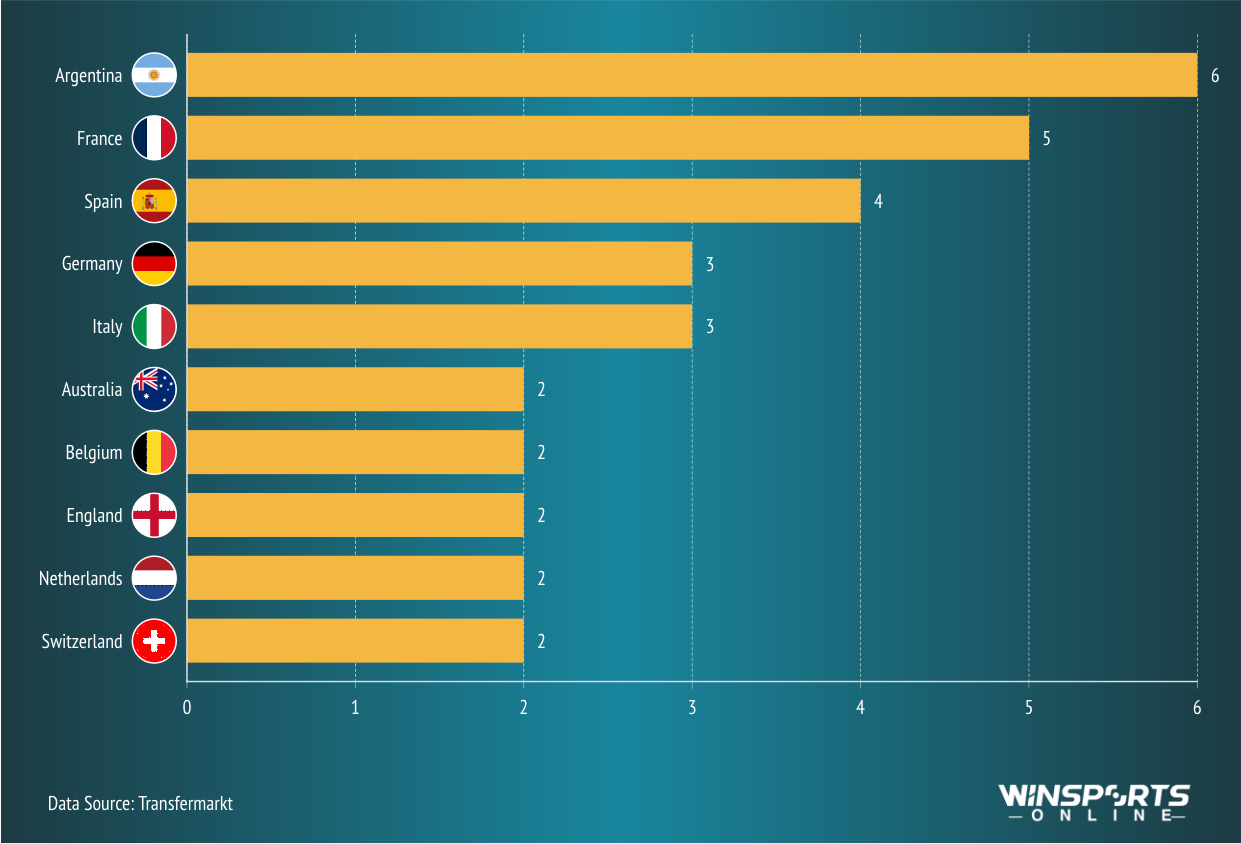
Italy is the first country that demands attention in this ranking, not because it sits at the top, but because of the contrast it creates. The Italian national team will not be part of the 2026 World Cup, yet Italian coaching will still have a visible presence through Ancelotti, Montella, and Cannavaro. That gives Italy three head coaches at the tournament despite having no team of its own on the pitch, a striking reminder that national failure on the field does not necessarily mean a lack of influence on the bench.
Only three countries rank above Italy. Argentina leads the entire table with six head coaches, giving it the strongest coaching footprint of any nationality at the tournament. Lionel Scaloni will guide Argentina itself, while Nestor Lorenzo, Sebastian Beccacece, Gustavo Alfaro, Mauricio Pochettino, and Marcelo Bielsa will all be working outside their homeland. France follows with five representatives, and Spain is next with four, leaving Italy and Germany tied on three each.
That means the top five coaching nationalities, Argentina, France, Spain, Germany, and Italy, account for 21 of the 48 benches at the tournament. In other words, fewer than one fifth of the nationalities represented in the coaching pool provide almost 44% of all World Cup head coaches. The concentration becomes even clearer when expanding to all countries with multiple representatives. There are only ten such countries, yet they account for 31 of the 48 teams.
Behind the leading five come Australia, Belgium, England, the Netherlands, and Switzerland, each with two head coaches at the 2026 World Cup. That leaves them well short of the front-runners, but still ahead of the 17 nationalities represented by just one manager, underlining how concentrated the dugouts remain despite the tournament’s global reach. That wider coaching map is also marked by a sharp generational contrast, stretching from Germany’s Julian Nagelsmann, the youngest head coach in the competition at 38, to Curaçao’s Dutch veteran Dick Advocaat, the oldest at 78. Together, they frame a 40-year gap across the World Cup touchlines.
Still, the most compelling contrast remains Italy’s. It is one thing for Argentina, France, or Spain to export several coaches while also competing at the World Cup themselves. It is another for Italy to miss the tournament completely and still send three managers into it. That gives the Italian presence a different weight, because it is not backed by the national team, but by the continued demand for Italian coaches abroad.
Taken together, the numbers show that the 2026 World Cup may feature 48 teams and 27 coaching nationalities, but influence on the touchline is concentrated in far fewer hands. Argentina leads the overall table, France and Spain remain close behind, and Italy stands out for a different reason altogether. The Azzurri will not be in the tournament, yet Italian coaching will still be impossible to miss.