Argentina and Brazil, the two South American giants, dominate the all-time card tables, while Panama posts the harshest yellow-card average
The 2026 World Cup has barely begun, yet discipline is already one of the tournament’s loudest storylines. Mexico’s opening 2-0 win over South Africa produced three red cards, an extraordinary total for a first match and the most in any World Cup game since the notorious Portugal-Netherlands clash in 2006. The scale of that chaos is even sharper when set against recent history: Qatar 2022 saw only four red cards in the entire tournament, meaning the new edition nearly matched that figure in a single night.
That dramatic opener is what led Winsportsonline to look beyond one match and examine which countries have built the strongest reputation for ill-discipline across World Cup history. Rather than focusing only on isolated incidents, the report compares three measures: total yellow cards, average yellow cards per match, and total red cards. Together, those numbers reveal two very different profiles – countries that accumulate huge disciplinary totals through decades of deep tournament runs, and countries that leave a much harsher mark every time they appear on the World Cup stage.
The all-time tables produce exactly that split. Argentina currently records the most yellow cards in World Cup history with 134, while Brazil leads the red-card table with 11. But the average-bookings table tells a different story altogether, with Panama on top at 3.67 yellow cards per match, ahead of Angola and Serbia on 3.33. Cameroon also stands out in the red-card ranking, matching Argentina’s total of nine dismissals despite playing only 26 World Cup matches to Argentina’s 88.
Key Takeaways:
- Argentina records the most yellow cards in World Cup history with 134, ahead of Germany on 118 and Brazil on 111
- Brazil leads the all-time red-card table with 11, while Argentina and Cameroon follow on nine each
- Panama posts the highest average number of yellow cards per World Cup match at 3.67, ahead of Angola and Serbia on 3.33
- Only three of the 10 countries with the highest average yellow-card rate in World Cup history are at the 2026 tournament – Panama, Ghana, and Iraq – and two of them, Panama and Ghana, have been drawn together in the same group
- Cameroon matches Argentina’s total of nine red cards despite playing only 26 World Cup matches, compared with Argentina’s 88
- Among the countries with the 10 highest all-time yellow-card totals, South Korea records the highest booking rate at 1.95 per match, ahead of the Netherlands on 1.84 and Argentina on 1.52
- The all-time yellow-card table is dominated by traditional World Cup heavyweights, but the per-match ranking is led by smaller or less frequent participants such as Panama, Angola, Slovenia, Togo, and Trinidad and Tobago
Teams With the Most Yellow Cards in World Cup History
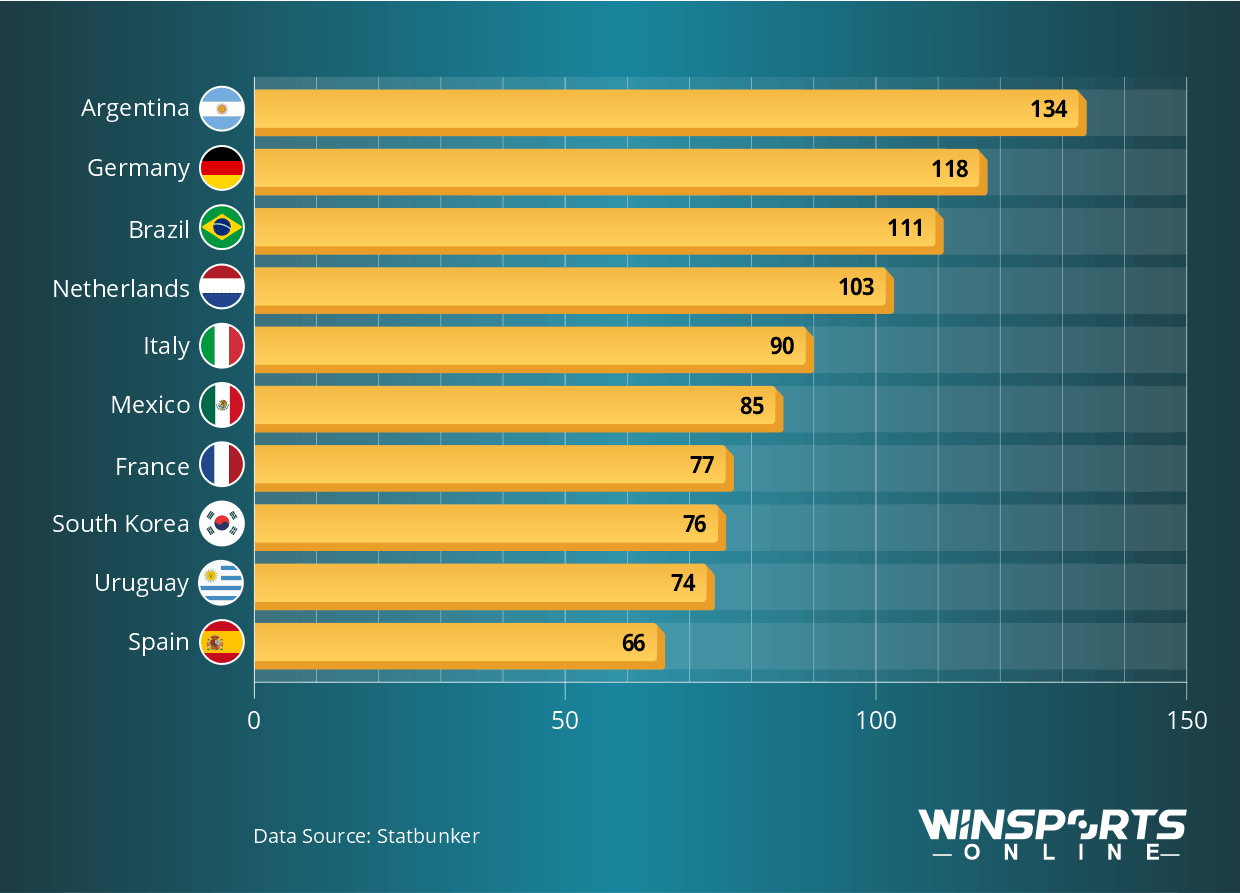
The broadest disciplinary story begins with the two South American giants. Argentina sets the pace for yellow cards with 134 in 88 World Cup matches, while Brazil sits third on 111 in 115. But when the focus shifts to red cards, Brazil moves to the top with 11, ahead of Argentina’s nine. So the same two countries that have helped shape the tournament’s footballing history also cast the longest disciplinary shadow over it. Argentina edges the booking count, Brazil the dismissals, and together they define the most combustible rivalry in the World Cup’s all-time disciplinary record.
The all-time yellow-card table is filled by countries whose World Cup history is built on repeated appearances and long campaigns deep into the tournament. Germany sits second on 118 yellow cards, followed by Brazil on 111, while the Netherlands rank fourth on 103 and Italy fifth on 90. Mexico place sixth on 85 and France seventh on 77, with South Korea eighth on 76, Uruguay ninth on 74, and Spain tenth on 66. Those numbers do not point only to the hottest tempers. They also reflect countries that spend so much time under World Cup pressure that cautions naturally build up over decades. The more often a country reaches the biggest stage, the more chances it has to see emotions fray and discipline tested.
Just outside the top 10, the gap is not especially wide. England sit 11th on 60 yellow cards from 74 matches, while Croatia follow on 58 from only 30, giving them a much sharper average of 1.93 per game. Portugal and the United States both have 55 yellow cards, but Portugal get there in 35 matches compared with 38 for the US, which again points to a higher booking rate. So while England are closest to the top 10 in raw total, Croatia and Portugal look much more aggressive when the same numbers are measured against matches played.
Teams With the Highest Average Number of Yellow Cards per World Cup Game
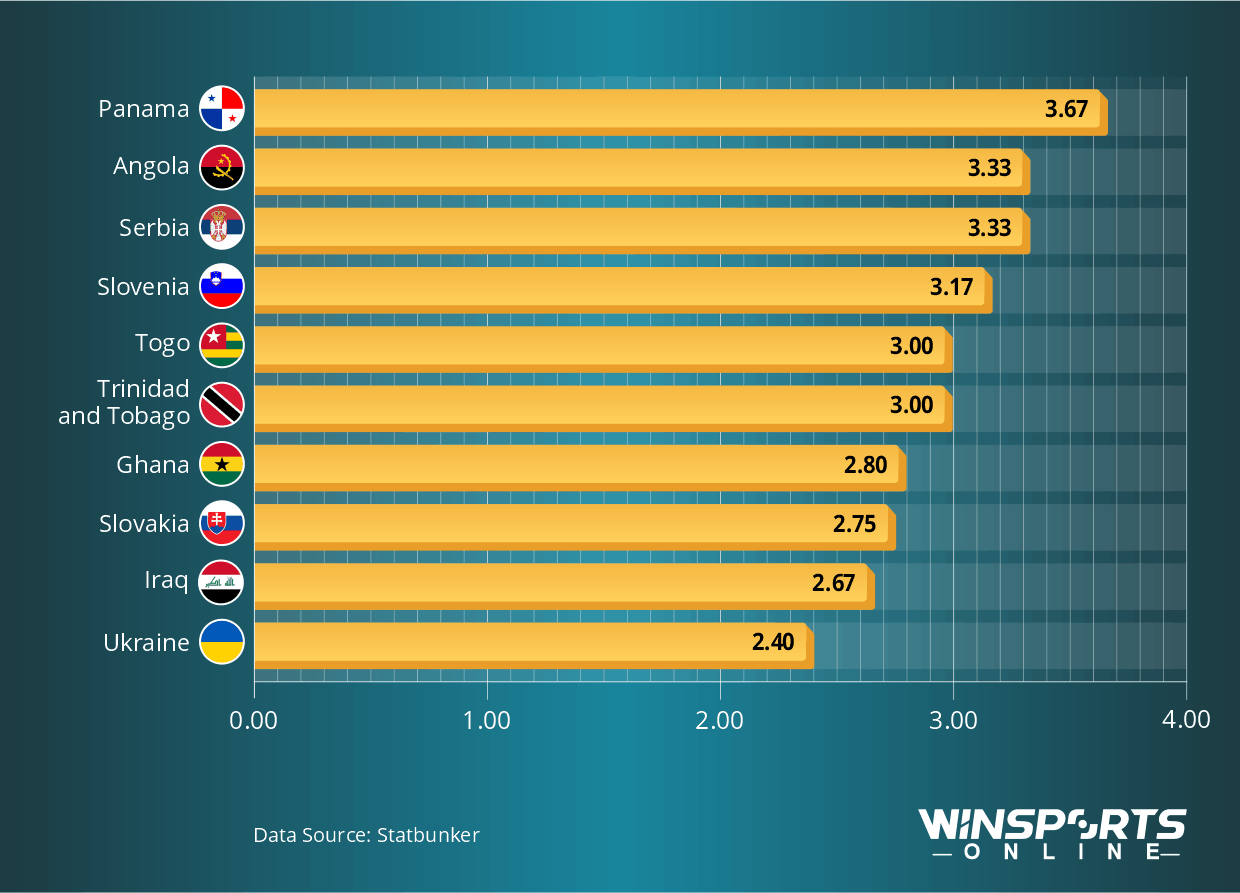
The per-match yellow-card table tells a very different story. Panama leads the ranking on 3.67 bookings per game, ahead of Angola and Serbia on 3.33, with Slovenia next on 3.17, all of them doing so in only three to nine World Cup matches. Togo and Trinidad and Tobago both sit on 3.00, also from just three games, while Ghana stands out on 2.80 across a much larger sample of 15 matches. This is where the report stops looking like a list of historical heavyweights and starts looking more like a study of football played with the temperature permanently high. These are not countries that simply accumulate cards through 70, 80, or 100 matches. They are countries whose World Cup games tend to become tense, scrappy, and bad-tempered very quickly.
Only three countries from the top 10 for average yellow cards per World Cup match are part of the 2026 field — Panama, Ghana, and Iraq — and two of them, Panama and Ghana, have been drawn together in the same group. So while Iraq carries that history into Group I, Group L already contains a pairing between two of the countries most likely to see matches played on edge, where tensions rise fast and discipline can come under strain.
Teams With the Most Red Cards in World Cup History
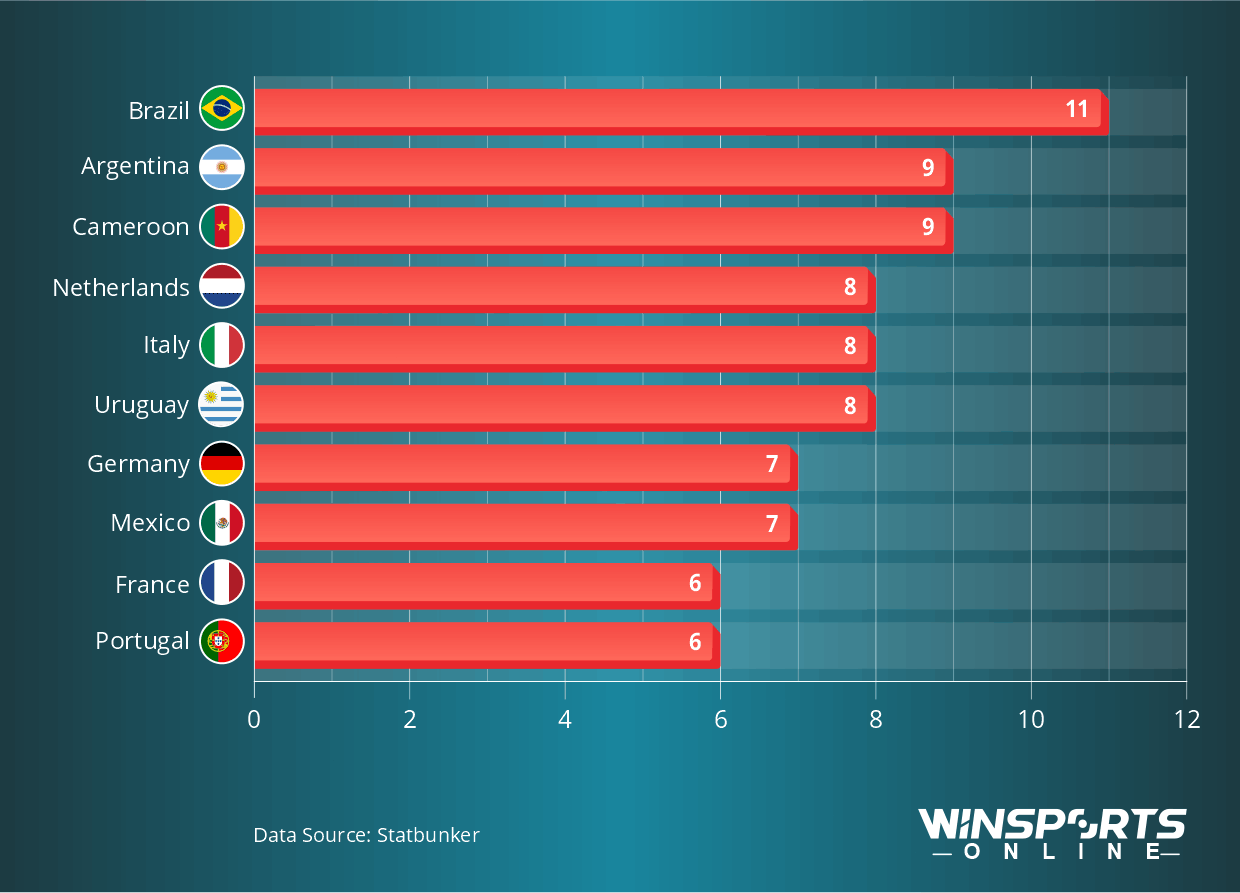
The red-card table is much tighter at the top. Brazil leads World Cup history with 11 dismissals in 115 matches, only two more than both Argentina and Cameroon, who share second place on nine each. That makes Cameroon the standout straight away, because it reaches the same total as Argentina in 62 fewer matches and sits only two behind Brazil despite appearing in 89 fewer. The next group is equally close, with the Netherlands, Italy, and Uruguay all on eight red cards. Even there, the contrast is sharp: the Netherlands gets to eight in 56 matches, Uruguay in 59, and Italy in 83.
Germany and Mexico follow on seven red cards each, but again the route to that figure is very different, with Germany needing 113 matches and Mexico only 61. France and Portugal complete the top 10 on six apiece, yet Portugal reaches that number in just 35 matches, compared with France’s 73. So while Brazil stands alone at the top on raw total, the broader top 10 shows very different disciplinary profiles: some countries get there through a long World Cup history, while others reach almost the same red-card numbers in far fewer appearances.
Methodology
The numbers cover each country’s World Cup disciplinary record up to the end of the most recent tournament before 2026, so the current edition is not included in the historical totals. Yellow-card averages are calculated by dividing each country’s total yellow cards by its number of World Cup matches.