Antoine Semenyo’s €72m move to Manchester City tops the list as Flamengo and Cruzeiro flex Brazil’s spending power
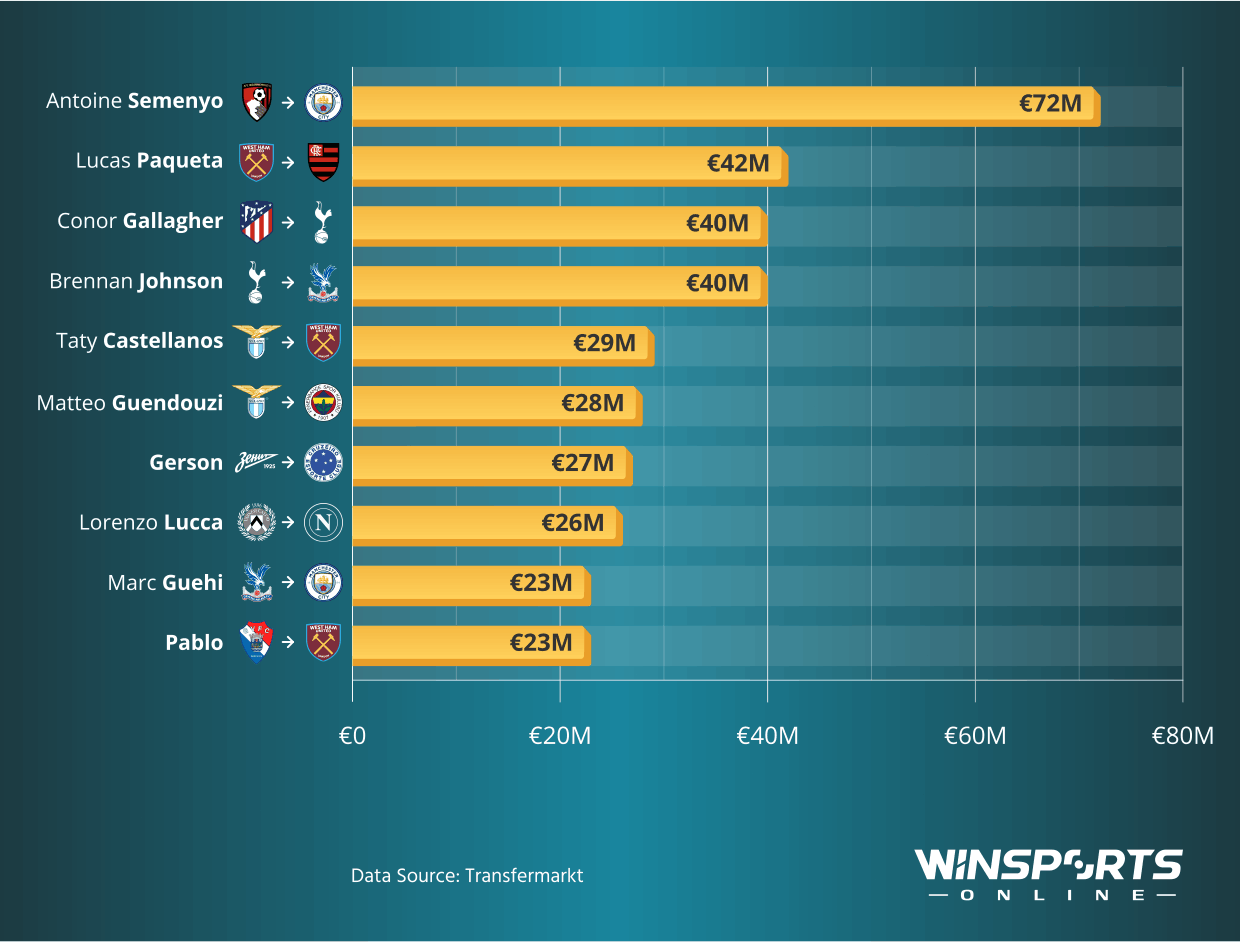
The January 2026 transfer window once again showed that winter is no longer just a time for short-term fixes. With league campaigns finely balanced and European knockout rounds approaching, several clubs chose to make bold moves rather than conservative tweaks. The biggest story came from Manchester City, who landed Bournemouth’s Antoine Semenyo for €72 million – by far the largest fee of the month and the kind of deal that would once have been reserved for the summer market.
Winsportsonline examined the 10 most expensive transfers completed in January 2026, tracking who spent, who sold and which clubs used the mid-season window to reshape their squads most aggressively. The list, headed by Semenyo’s switch to Manchester City, runs through a cluster of €20-40 million deals that underline how Premier League clubs still set the pace, but also how Italy, Portugal and Brazil remain key suppliers in the global market.
Key Takeaways:
- The 10 most expensive January 2026 transfers amount to €350 million in total fees
- Premier League clubs account for six of the ten most expensive transfers of the January 2026 window
- Manchester City completed the biggest deal of the window with Antoine Semenyo (€72m) and spent €95m in total after also signing Marc Guehi
- Tottenham and Crystal Palace were involved in a €40m-to-€40m reshuffle around Brennan Johnson and Conor Gallagher, without increasing Spurs’ net spend at the top end
- West Ham were the only club to appear three times on the list, selling Lucas Paqueta to Flamengo for €42m while signing Taty Castellanos (€29m) and Pablo (€23m)
- Lazio acted as the major sellers, moving two players from this top-10 bracket
- Flamengo and Cruzeiro are the only non-European clubs among the buyers, with the signings of Paqueta and Gerson resetting the Brazilian transfer record twice in the same window
The Most Expensive January 2026 Transfers
Premier League: City’s power and a reshuffle in London
Premier League clubs continue to dominate the upper end of the January table, with Manchester City, Tottenham, Crystal Palace and West Ham all heavily involved. City sat at the centre of the story, spending €72 million to prise Antoine Semenyo from Bournemouth and another €23 million to sign Marc Guehi from Crystal Palace, for a combined €95 million outlay on two established players. One move targeted their frontline, the other their defensive core – a clear signal that Pep Guardiola’s side were prepared to pay summer-level prices in January to stay ahead both domestically and in Europe.
London clubs supplied much of the rest of the Premier League movement. Tottenham appear on the list twice at €40 million: they paid that amount to bring Conor Gallagher back from Atletico Madrid, and they received the same fee from Crystal Palace for Brennan Johnson. In practical terms, Spurs reshaped their midfield and forward line without adding net transfer spend at the very top of the market. Palace, for their part, are one of the busiest clubs in this group – selling Guehi to City for €23 million but committing €40 million to sign Johnson, a €17 million net investment aimed at boosting their attacking threat.
West Ham’s business completed the English picture. The Hammers sold Lucas Paqueta to Flamengo for €42 million and reinvested heavily with two sizeable incoming moves: €29 million for Lazio’s Taty Castellanos and €23 million for Pablo from Gil Vicente. That €52 million combined spend underlined how the fight for survival in England now pushes clubs outside the traditional “big six” to operate at a financial level once reserved for the very top.
Outside the Premier League, Lazio are the biggest sellers. They received €29 million from West Ham for Taty Castellanos and €28 million from Fenerbahce for Matteo Guendouzi, banking €57 million in fees from just two outgoing players. Rather than buying their way onto this list, the Roman club appeared as one of the window’s most prominent sellers, with Premier League and Turkish money flowing into the Italian capital as Lazio reshaped their attack and midfield on the fly.
Gerson and Paqueta: Brazil’s record-breaking swing back from Europe
Two of the most eye-catching moves on the list took place outside Europe. Lucas Paqueta’s €42 million transfer from West Ham to Flamengo and Gerson’s €27 million switch from Zenit to Cruzeiro both stood out as major deals returning high-value players from European clubs to Brazilian Serie A. Gerson’s move first set a new Brazilian transfer record, only to be eclipsed later in the window by Paqueta, whose fee now stands as the highest incoming transfer in the league’s history.
While the Premier League and Serie A remained in control of the buying side within Europe, these transfers underlined how ambitious Brazilian clubs are increasingly able to participate in the global market at fee levels that were previously out of reach. The Brazilian Serie A position itself as a realistic destination for established names still in their prime, not just for players returning at the very end of their careers.
A compressed market with a clear financial hierarchy
The 10 most expensive January 2026 transfers formed a compact but clearly tiered market. The €350 million total was driven overwhelmingly by Premier League buyers, who accounted for the bulk of the spending through Manchester City, Tottenham, Crystal Palace and West Ham, while Brazilian clubs seized the moment to repatriate Paqueta and Gerson for record sums.
At club level, Manchester City were the only side to make two signings in this bracket and the only one to push above €50 million on a single player. West Ham’s triple involvement, Tottenham’s balanced trade around Gallagher and Johnson, and Crystal Palace’s reinvestment after selling Guehi all showed how English clubs used the winter window not only to plug gaps, but to re-profile their squads in real time. Around them, a pair of Brazilian giants picked their spots to step into a market that remains firmly shaped by Premier League spending power.