Barcelona, Real Madrid, and Bayern Munich top the ranking as Al-Hilal and Manchester United post the biggest drops
Football transfers are often measured by the huge fees paid for star players, but another key question is how well those investments hold their value over time. This week, Winsportsonline compared the total cost of assembling each squad with its current market value to reveal which clubs have increased their worth – and which have lost hundreds of millions. The analysis is based on the transfer fees paid for every player currently in a club’s squad, excluding those sent out on loan, providing a clear picture of the money invested and how that compares to the squad’s present valuation. We have highlighted the top 10 clubs with the greatest gains and the top 10 with the steepest drops between squad costs and current valuations.
The positive ranking includes clubs from six different leagues, with La Liga standing out through three representatives – Barcelona, Real Madrid, and Athletic Club. Germany follows with two clubs (Bayern Munich and Eintracht Frankfurt), as does Portugal (Sporting Lisbon and Porto), while Italy (Inter), France (PSG) and England (Arsenal) each have one club in the top 10. Barcelona top the list with a €710.9 million increase, ahead of Real Madrid (€645.0 million) and Bayern Munich (€539.65 million), highlighting how elite squads built through a mix of academy production and smart recruitment can generate enormous market value growth.
Key Takeaways:
- Barcelona lead the positive ranking with a €710.9 million squad value increase, followed by Real Madrid (€645.0 million) and Bayern Munich (€539.65 million)
- La Liga places three clubs in the top 10 for highest squad value increases – Barcelona, Real Madrid, and Athletic Club – the most of any league
- The Saudi Pro League dominates the negative ranking, with six clubs in the bottom 10 and the five worst drops led by Al-Hilal (-€252.22 million)
- Manchester United record the second-biggest loss at -€226.37 million, the largest negative difference outside Saudi Arabia
- Sporting Lisbon and Porto both feature in the top 10 gainers, making Liga Portugal one of only two leagues with multiple clubs in the positive ranking alongside La Liga
Football Clubs Ranked by Difference between Purchase and Current Market Value of their Squads
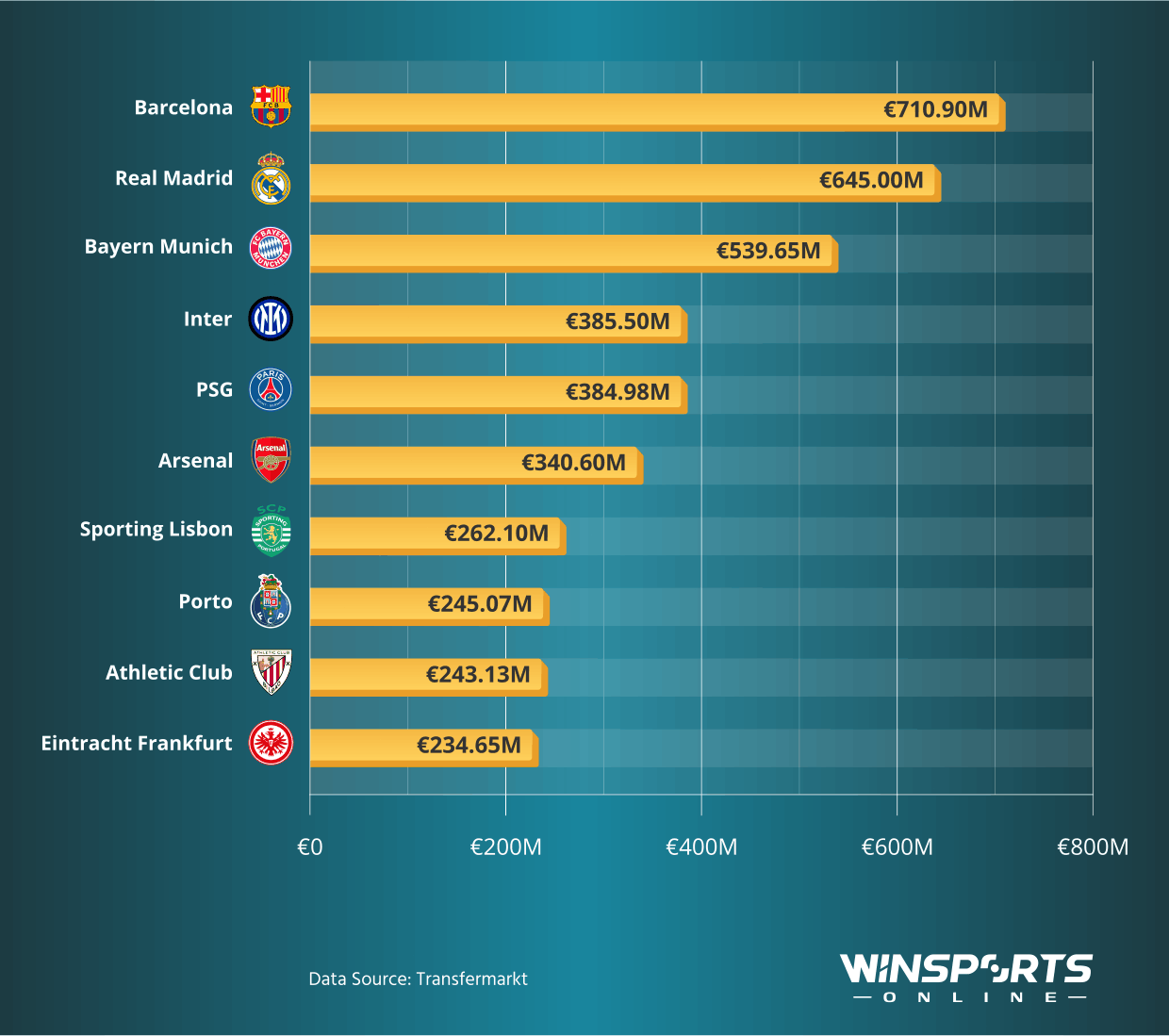
- The best example of success in this analysis is Barcelona. The Catalans have spent €399.5 million to build the current squad, which is now valued at €1,110.4 million – an increase of €710.9 million. Their position at the top is fuelled by a squad profile that leans heavily on La Masia development, with key value coming from academy-nurtured players such as Pedri, Gavi, Lamine Yamal and Fermin Lopez, alongside other internally developed assets. Barcelona’s squad now sits above the billion-euro mark in market valuation, despite being assembled for under €400 million in purchase cost, underlining how development-driven squad building can generate huge appreciation without matching the transfer outlay of Europe’s biggest spenders.
- Real Madrid rank second in this ranking with a difference of €645.0 million. The club have spent €708.0 million to build a squad now valued at €1,353.0 million. Madrid’s growth reflects a different strategy to Barcelona’s, built around pulling in established stars and elite-level talent, including headline arrivals without a transfer fee such as Kylian Mbappe. At the same time, two of their most valuable long-term assets, Vinicius and Rodrygo, were signed as teenagers and have since seen their market values rise dramatically, turning early recruitment bets into core value pillars. Their current valuation remains the highest in the dataset, underlining how a mix of superstar pull and youth-market upside keeps Real Madrid at the top end of squad worth.
- Bayern Munich complete the top three with a positive balance of €539.65 million. After investing €420.3 million into the squad, its current market value stands at €959.95 million. Bayern’s presence near the top shows how strongly the Bundesliga’s biggest club has retained and increased value through a squad that remains just below the €1 billion threshold. Their ability to maintain a high-value core while keeping purchase costs comparatively controlled has produced one of the strongest value gaps in the ranking.
- Inter sit fourth with a €385.5 million difference. The Italian club has spent €281.3 million on its squad, now worth €666.8 million. Inter’s position highlights a model built around strategic recruitment, where a relatively modest purchase cost has been turned into a squad valued well above €600 million. Their ability to build a high-value group without major transfer expenditure places them among the most efficient clubs in Europe in this comparison.
- PSG are fifth with a €384.98 million difference. The French champions have spent €812.52 million to build a squad now valued at €1,197.5 million. Unlike the clubs above them, PSG’s ranking is built on massive investment, but their market value still exceeds the purchase cost by almost €385 million. Their squad remains one of only three in the dataset above €1.1 billion, reflecting how much elite talent is concentrated in Paris.
- Arsenal rank sixth with a difference of €340.6 million. The Premier League side have spent €925.4 million to assemble the squad, which is now valued at €1,266.0 million. Arsenal’s presence in the top 10 shows how a high-spending recruitment cycle can still translate into market value growth when the squad is built around players who retain strong resale potential. Their current valuation places them among Europe’s most expensive squads, and still comfortably above the cost of building it.
- Sporting Lisbon come seventh with a €262.1 million difference. The Portuguese side have spent €201.9 million to build a squad currently valued at €464.0 million. Sporting’s presence reflects a club model built on development and resale strength, where investment remains controlled but market value growth is consistently strong. Their squad value is more than double their purchase cost, placing them among the standout value builders outside the top five leagues.
- Porto follow in eighth with a difference of €245.07 million. After spending €186.33 million, their squad is now valued at €431.4 million. Porto’s numbers reinforce the same Liga Portugal pattern seen with Sporting: a relatively low purchase cost paired with strong market value appreciation. Their place in the top 10 shows how Portugal’s biggest clubs continue to operate as elite-value builders despite far smaller budgets than Europe’s financial giants.
- Athletic Club rank ninth with a difference of €243.13 million. The Basque side have built a squad valued at €304.01 million after spending just €60.88 million. Their position stands out as one of the most extreme efficiency cases in the entire dataset, with a squad worth five times its purchase cost. Athletic’s ability to generate value through internal production is reflected clearly in this gap, even without the financial power of Europe’s biggest clubs.
- Eintracht Frankfurt complete the top ten with a €234.65 million difference. The Bundesliga club have spent €155.4 million to build a squad now valued at €390.05 million. Frankfurt’s place in the ranking underlines how a well-run recruitment model can create major squad appreciation even outside the elite spending tier. Their numbers place them alongside Bayern as Germany’s second representative in the positive top 10.
Football Clubs Ranked by Negative Difference between Purchase and Current Market Value of their Squads
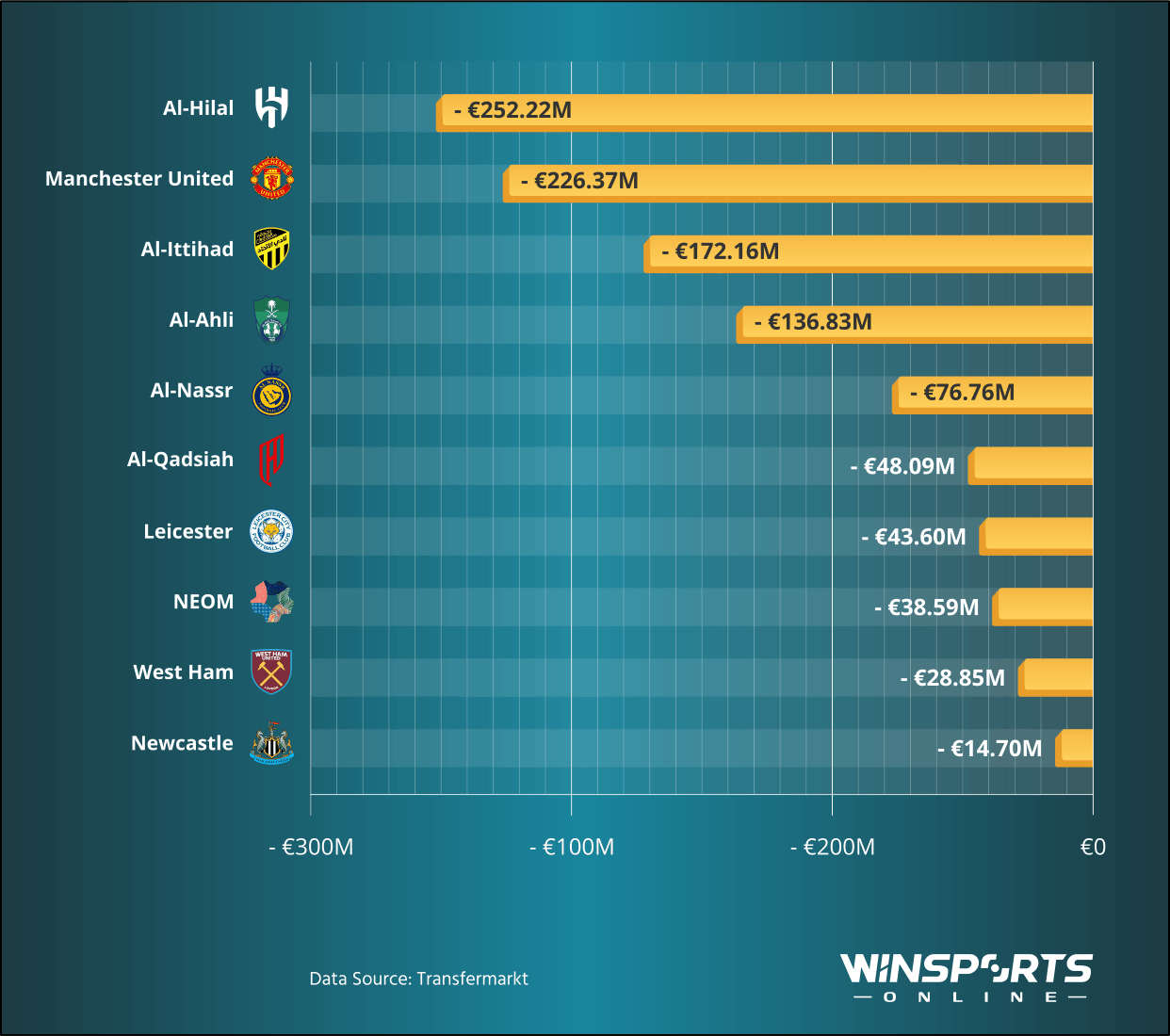
- Al-Hilal lead the negative ranking with a difference of -€252.22 million. The Saudi club have spent €451.52 million to build their squad, which is currently valued at just €199.3 million. Their position at the bottom reflects the sharp depreciation that comes when spending is focused on older players with limited resale potential. Despite assembling one of the most expensive squads in the Saudi Pro League, the market value has fallen far below the purchase cost.
- Manchester United rank second in the negative table with a difference of -€226.37 million. The Premier League club have invested €945.52 million into their current squad, now valued at €719.15 million. United are the clearest example in the dataset of how extreme investment does not automatically translate into long-term value growth. Even with one of the most expensive squads in world football by purchase cost, the current valuation remains well below the money spent to build it.
- Al-Ittihad follow with a negative balance of -€172.16 million. The club have spent €336.71 million, and their squad is now valued at €164.55 million. Their place near the bottom continues the same Saudi Pro League trend: heavy spending combined with rapid depreciation. The gap reflects a squad profile shaped by marquee signings whose market value declines quickly.
- Al-Ahli sit fourth with a difference of -€136.83 million. After investing €307.61 million, their squad is now valued at €170.78 million. Like the other Saudi clubs in the ranking, the numbers point to a model where transfer spending has not been matched by lasting squad worth. The market value remains far below the purchase cost, highlighting how quickly value can fall when resale strength is not a priority.
- Al-Nassr rank fifth with a negative balance of -€76.76 million. The club have spent €210.16 million and are currently valued at €133.4 million. Their drop is smaller than the clubs above them, but still substantial, reflecting the same structural challenge. Even with major spending, the squad’s current market value sits well below the investment made to assemble it.
- Al-Qadsiah are sixth with a difference of -€48.09 million. The Saudi side have spent €167.82 million and are now valued at €119.73 million. Their inclusion reinforces how widely the depreciation pattern stretches across the Saudi Pro League, not just among the traditional giants. The gap remains large enough to place them among the 10 steepest drops in the dataset.
- Leicester rank seventh with a negative balance of -€43.6 million. The Championship side have spent €186.0 million to build a squad valued at €142.4 million. Leicester are the only non-top-flight European club in the negative ranking, and their presence reflects how market value can fall when a team drops out of the Premier League spotlight. Even without the extreme spending seen in Saudi Arabia, the squad’s valuation sits notably below the purchase cost.
- NEOM follow in eighth with a difference of -€38.59 million. The Saudi club have invested €120.74 million and their squad is now valued at €82.15 million. Their place in the bottom 10 underlines again how quickly squad value can depreciate in the Saudi market. Even with a lower overall spend than the league’s biggest clubs, the drop remains steep enough to rank among the worst in the dataset.
- West Ham sit ninth with a difference of -€28.85 million. The Premier League club have spent €367.8 million and are currently valued at €338.95 million. Their negative gap is far smaller than Manchester United’s, but still places them among the 10 worst performers. West Ham’s position highlights how even Premier League squads can fall below purchase cost, especially when recruitment cycles do not translate into sustained market value growth.
- Newcastle complete the bottom 10 with a difference of -€14.7 million. The club has invested €724.25 million into the squad, which is now valued at €709.55 million. Newcastle’s gap is the smallest in the negative ranking, but still places them on the wrong side of the table. Their position reflects a squad whose market value has largely held close to its purchase cost, but not risen above it enough to avoid inclusion among the 10 steepest drops.