Raphinha has 12 league goals but accounts for 38.71% of Barcelona’s total, almost identical to Mbappé and Haaland, while Budimir leads the ranking at 83.33%
Raphinha’s extraordinary start to the season made Barcelona impossible to ignore. Back-to-back hat-tricks in La Liga have taken the Brazilian to 12 league goals already, while Barcelona as a whole have scored 31. That means Raphinha alone has provided 38.71% of their league goals, despite playing in one of the most productive attacks in Europe.
His form prompted Winsportsonline to look beyond the usual goalscorer standings. Instead of simply asking who has scored the most, we compared the leading scorers from the Premier League, La Liga, Serie A, Bundesliga, Ligue 1, Eredivisie and Liga Portugal with their teams’ total league goals. The question was simple: how much of each club’s scoring is actually coming from its main goalscorer?
Raphinha is far from alone among Europe’s biggest names. Kylian Mbappé has scored seven of Real Madrid’s 18 league goals, giving him a 38.89% share, while Erling Haaland is responsible for five of Manchester City’s 13, or 38.46%. Donyell Malen has contributed six of Roma’s 14 goals, a considerably higher 42.86%, while Ferran Torres stands out even more: four of PSG’s eight league goals have come from him, giving the forward an exact 50% share.
Yet none of them leads the ranking. That distinction belongs to Ante Budimir, whose five goals account for five of Osasuna’s six in La Liga – an extraordinary 83.33%. So while Raphinha’s record-breaking form provided the starting point for the study, the comparison reveals something quite different: the player scoring the most goals is not necessarily the one carrying the largest share of his team’s attack.
Key Takeaways:
- Raphinha has exploded to 12 league goals in just seven La Liga matches, the highest total among the players analysed. Yet Barcelona’s own 31-goal start leaves him only 13th by share of team goals, at 38.71%
- Kylian Mbappé, Raphinha and Erling Haaland are almost impossible to separate on this measure: they have scored 38.89%, 38.71% and 38.46% of Real Madrid, Barcelona and Manchester City’s league goals respectively
- Ferran Torres has scored half of PSG’s league goals. His four goals represent 50% of the French champions’ total, despite Raphinha having scored three times as many
- Donyell Malen also ranks above Raphinha by share, with his six goals accounting for 42.86% of Roma’s league total
- Raphinha and Lamine Yamal have scored 19 of Barcelona’s 31 league goals between them, meaning the pair are responsible for 61.29% of the club’s scoring
- Seven of the 22 players analysed have scored at least half of all their team’s league goals, showing how heavily several clubs have relied on one main scorer
- Ante Budimir is the extraordinary outlier. He has scored five of Osasuna’s six league goals – 83.33%, almost 20 percentage points more than anyone else in the ranking
Top Scorers in Europe
and Their Share of Teams’ League Goals
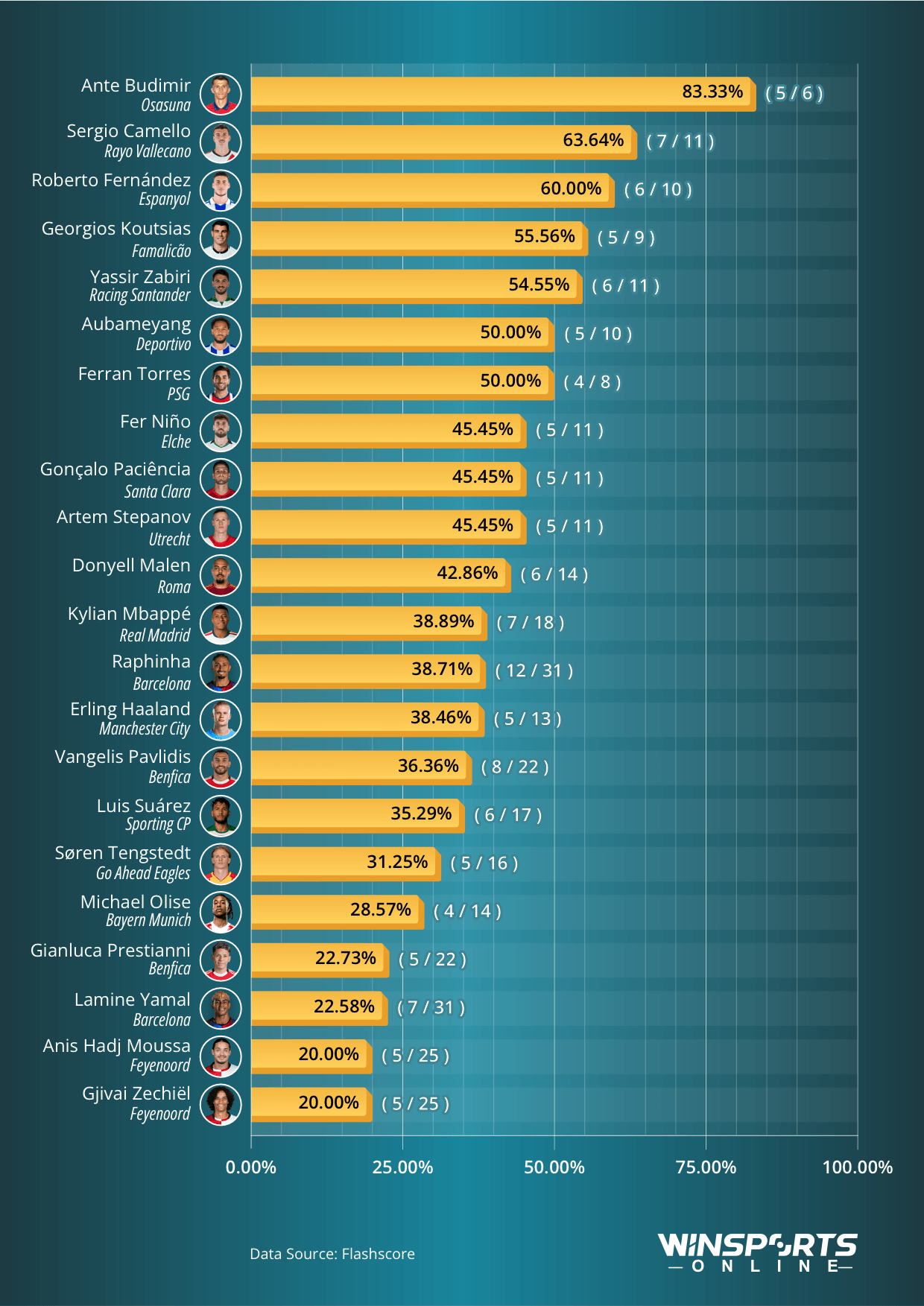
Mbappé, Raphinha and Haaland Are Separated by Less Than Half a Percentage Point
Three of the most recognisable forwards in European football are producing remarkably similar shares of their teams’ league goals.
Mbappé sits on 38.89% after scoring seven of Real Madrid’s 18, Raphinha follows at 38.71% with 12 of Barcelona’s 31, and Haaland is only fractionally behind on 38.46% after contributing five of Manchester City’s 13. Just 0.43 percentage points separate all three.
What makes the comparison interesting is how different their raw totals are. Raphinha has scored more than twice as many league goals as Haaland, yet Barcelona have also scored far more as a team. Once each player’s goals are measured against his club’s total, their individual importance looks almost identical.
Ferran Torres and Malen Carry an Even Bigger Share
Several high-profile players actually sit above that trio when the comparison shifts from total goals to percentage of team scoring.
Ferran Torres has scored four of PSG’s eight league goals, meaning exactly half of the French champions’ total has come from him. Donyell Malen is also above the 40% mark, with six goals from Roma’s 14 giving him a 42.86% share.
Vangelis Pavlidis has scored eight times for Benfica, the second-highest individual total in the study behind Raphinha, but Benfica’s 22 league goals leave him on 36.36%. Luis Suárez has six of Sporting CP’s 17, or 35.29%, while Michael Olise accounts for four of Bayern Munich’s 14 at 28.57%.
The comparison shows why the league scoring table alone can be misleading when assessing how dependent a club is on one player. A forward can have fewer goals than another star but still account for a much larger part of everything his team has produced.
Barcelona Have Two of the Leading Scorers but Their Goals Are Spread Around
Barcelona are also unusual because two players from the same side feature prominently. Raphinha has 12 goals and Lamine Yamal seven, giving the pair 19 of Barcelona’s 31 league goals between them.
Raphinha alone accounts for 38.71%, while Yamal contributes another 22.58%. Together, they have scored 61.29% of Barcelona’s league goals.
Benfica show a similar pattern. Pavlidis and Gianluca Prestianni have combined for 13 of the club’s 22 goals, or 59.09%. Feyenoord also have two players in the study, although Anis Hadj Moussa and Gjivai Zechiël each account for only 20% of the Dutch club’s 25-goal total.
Budimir Is the Clear Outlier
For all the attention surrounding Raphinha, Mbappé, Haaland and the other major names, nobody comes close to Ante Budimir.
The Osasuna striker has scored five of his team’s six league goals, giving him an 83.33% share. Sergio Camello is next with seven of Rayo Vallecano’s 11 at 63.64%, while Roberto Fernández has six of Espanyol’s 10 for 60%.
Budimir’s number is particularly striking when placed alongside the superstars. His five goals are less than half Raphinha’s total of 12, yet his share of Osasuna’s scoring is more than twice as large. That contrast is exactly what this ranking is designed to show: not simply who is scoring the most, but which leading scorers are contributing the greatest part of everything their teams produce.