Real Madrid lead with €338.25m, while 13 of the 24 clubs paying over €100m are from the Premier League
Wage bills offer one of the clearest ways to compare the financial power of football clubs. Transfer spending can swing dramatically from one window to the next, but salaries represent a recurring commitment and reveal how much teams are prepared to spend simply to maintain their first-team squads.
Across Europe, those commitments vary enormously. The financial gap is visible not only between the continent’s biggest and smallest clubs, but also between domestic leagues and between teams competing in the UEFA tournaments, newly promoted sides and the rest of their national competitions.
Winsportsonline analysed the estimated gross fixed first-team wages of all 132 clubs in the Premier League, La Liga, Serie A, Bundesliga, Ligue 1, Liga Portugal and the Eredivisie for the 2026/27 season, comparing individual clubs, league-wide spending and the averages of different groups within each competition.
Real Madrid have Europe’s largest fixed first-team wage bill at €338.25m and are the only club above €300 million. Manchester City follow at €282.44m, Liverpool at €260.50m and Barcelona at €251.46m, while ten clubs in total spend more than €200 million a year. Of the 24 teams whose payroll exceeds €100 million, 13 are from England and only 11 from the other six leagues combined.
The Premier League’s financial advantage extends well beyond its biggest clubs. Its 20 teams spend €2.82 billion in fixed first-team wages, more than La Liga and Serie A combined, while the average English club pays €141.12m, almost twice the La Liga average of €73.42m. Spain, Italy and Germany show much sharper divisions between clubs participating in UEFA tournaments and the rest of their domestic leagues, while Portugal and the Netherlands produce the opposite surprise at the lower end: newly promoted teams average slightly more in fixed wages than established clubs outside European competition.
Key Takeaways:
- Twenty-four clubs spend more than €100 million a year on fixed first-team wages, and only 11 of them are outside England
- Real Madrid are the only club with fixed first-team wages above €300 million, at €338.25m
- Ten clubs spend more than €200 million a year, with six of them from the Premier League. Manchester City (€282.44m) and Liverpool (€260.50m) follow Real Madrid, with Barcelona (€251.46m) the fourth club above €250 million
- The Premier League’s €2.82 billion total is larger than La Liga and Serie A combined, whose clubs spend €2.73 billion between them
- The average Premier League club pays €141.12m, almost twice La Liga’s €73.42m and more than double the averages in Serie A (€63.24m) and the Bundesliga (€62.31m)
- Teams competing in UEFA tournaments have the highest average wage bill in every one of the seven leagues. The difference is particularly pronounced in La Liga, where they average €130.25m compared with €39.78m among established clubs outside European competition
- Liga Portugal and the Eredivisie break the pattern seen in the other five leagues: newly promoted clubs average slightly higher fixed wages than established clubs outside UEFA competition, at €7.46m versus €7.31m in Portugal and €7.53m versus €7.28m in the Netherlands
24 clubs belong to Europe’s €100m wage group
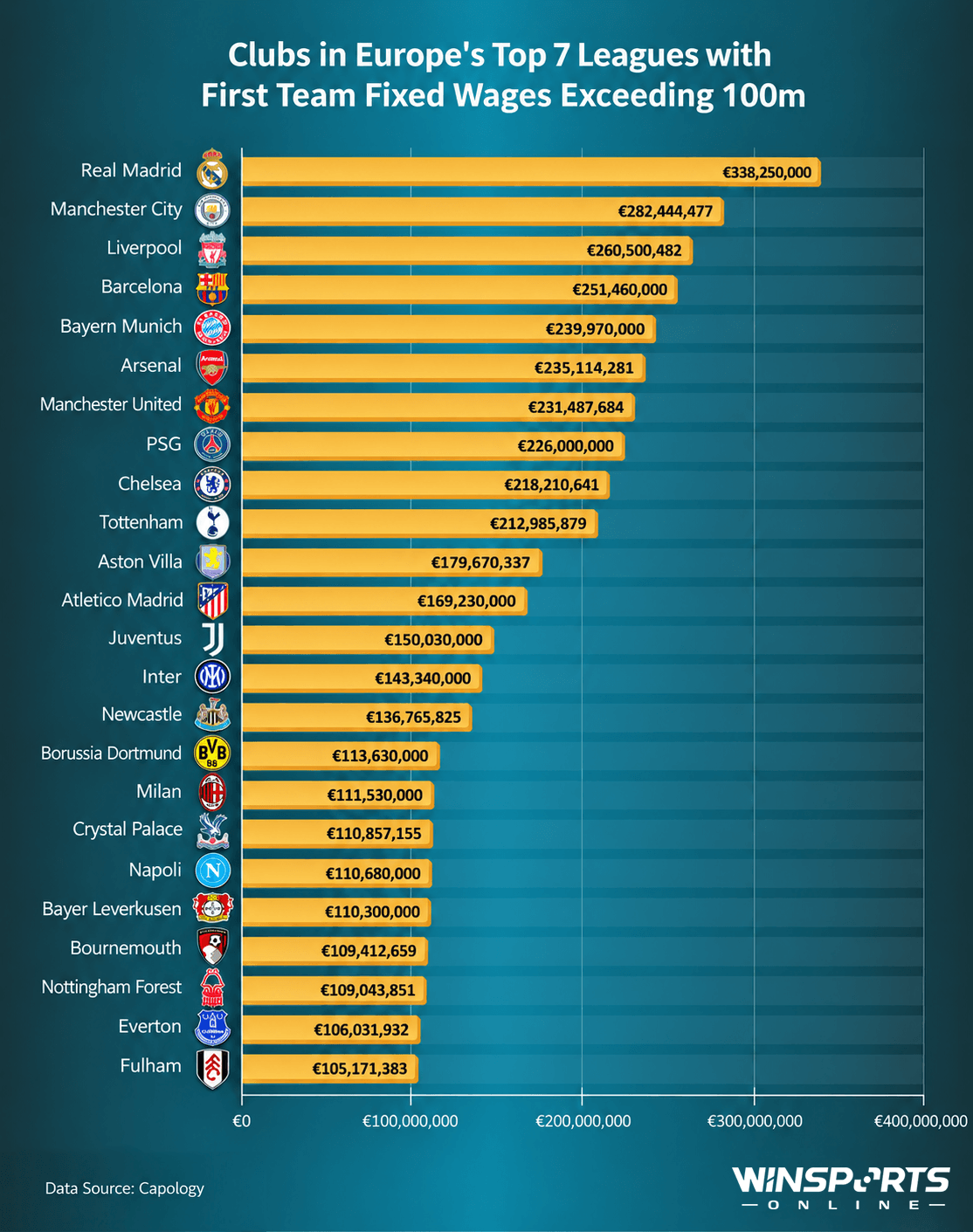
The €100 million line creates a very clear dividing point in the dataset. Twenty-four clubs exceed it, and the distribution immediately shows where the financial weight sits in European football.
Real Madrid top the list at €338.25m, making them the highest-paying club in the study. Manchester City rank second at €282.44m, followed by Liverpool at €260.50m and Barcelona at €251.46m. Bayern Munich complete the top five at €239.97m.
The Premier League is by far the most heavily represented competition. In addition to Manchester City and Liverpool, the English top flight places Arsenal, Manchester United, Chelsea, Tottenham, Aston Villa, Newcastle, Crystal Palace, Bournemouth, Nottingham Forest, Everton and Fulham above the €100 million mark. That means the Premier League alone supplies more than half of all clubs in Europe’s €100m wage group.
Elsewhere, La Liga contributes Real Madrid, Barcelona and Atletico Madrid, Serie A places Juventus, Inter, Milan and Napoli in the group, and the Bundesliga is represented by Bayern Munich, Borussia Dortmund and Bayer Leverkusen. Paris Saint-Germain are Ligue 1’s only member of the €100m club, and no side from either Liga Portugal or the Eredivisie reaches the threshold.
That distribution says a great deal about how spending power is spread. Some leagues rely on a very small elite at the top, whereas the Premier League extends €100m-level salary spending much deeper into the table.
Premier League clubs spend €2.82 billion in total fixed wages
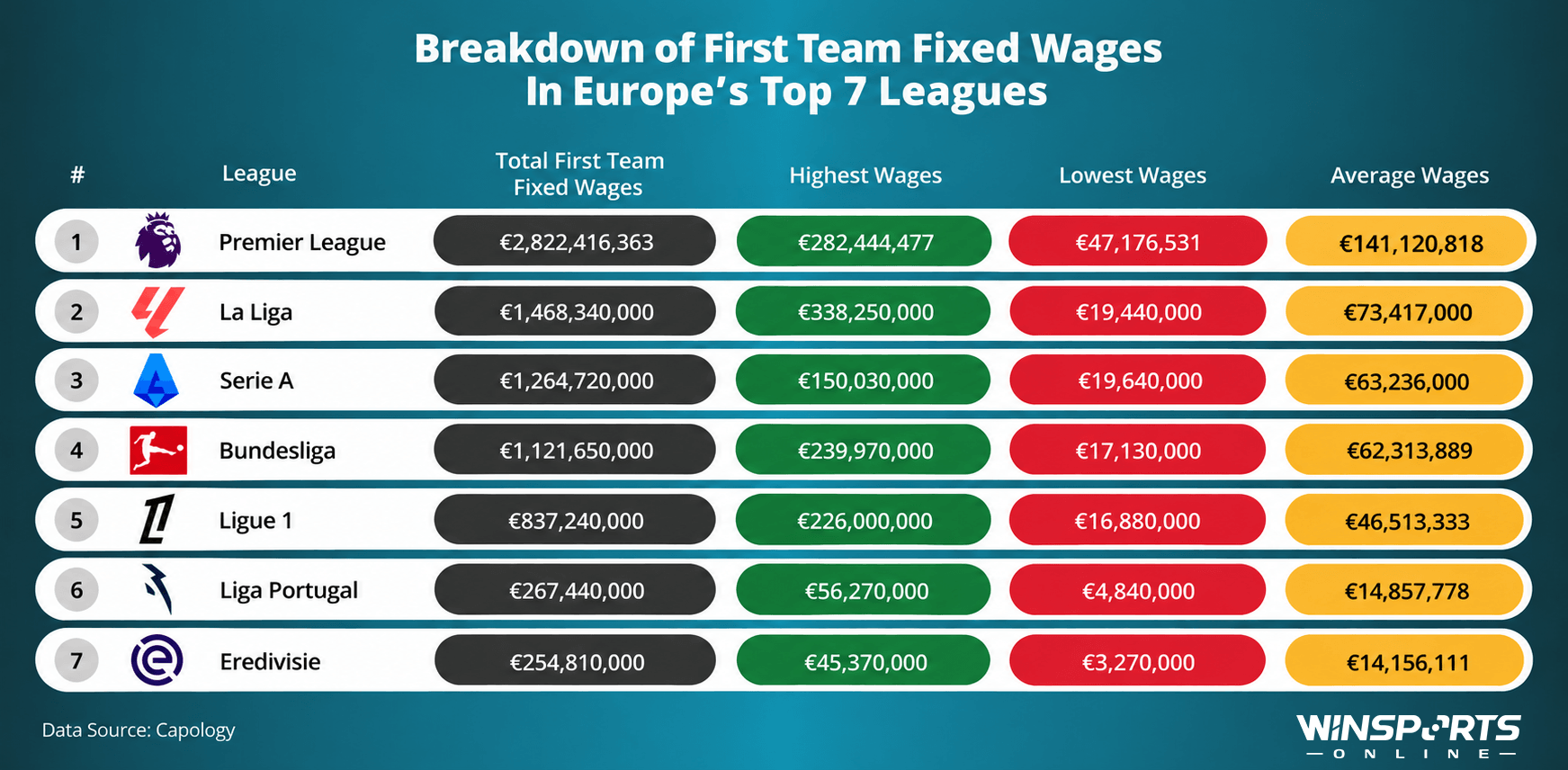
At league level, the Premier League sits in a category of its own. Its clubs combine for €2.82 billion in fixed first-team salaries, comfortably the largest total across the seven leagues and more than one-third of their combined outlay.
La Liga ranks second on €1.47 billion, with Serie A next on €1.26 billion and the Bundesliga close behind on €1.12 billion. Ligue 1 follows at €837.24m, while the totals drop sharply in Portugal and the Netherlands, where Liga Portugal stands at €267.44m and the Eredivisie at €254.81m.
The average figures underline the same hierarchy. The average Premier League club pays €141.12m, almost twice the €73.42m recorded in La Liga and comfortably above Serie A’s €63.24m and the Bundesliga’s €62.31m. Ligue 1 comes in at €46.51m per club, with Liga Portugal and the Eredivisie both just above €14m.
The table also shows how uneven some competitions are internally. La Liga combines the highest salary bill in the entire dataset, Real Madrid’s €338.25m, with the lowest in Spain at Málaga’s €19.44m. The Bundesliga ranges from Bayern Munich’s €239.97m to Paderborn’s €17.13m, and Ligue 1 stretches from PSG’s €226m to Le Mans on €16.88m. Portugal and the Netherlands operate on a far smaller scale overall, with Benfica highest on €56.27m and Ajax on €45.37m.
Taken together, the numbers show that the Premier League is not only the richest league in total, but also by average club spending, while the next three leagues – La Liga, Serie A and the Bundesliga – form a second tier well ahead of Ligue 1, Liga Portugal and the Eredivisie.
Clubs participating in UEFA tournaments set the pace in every league
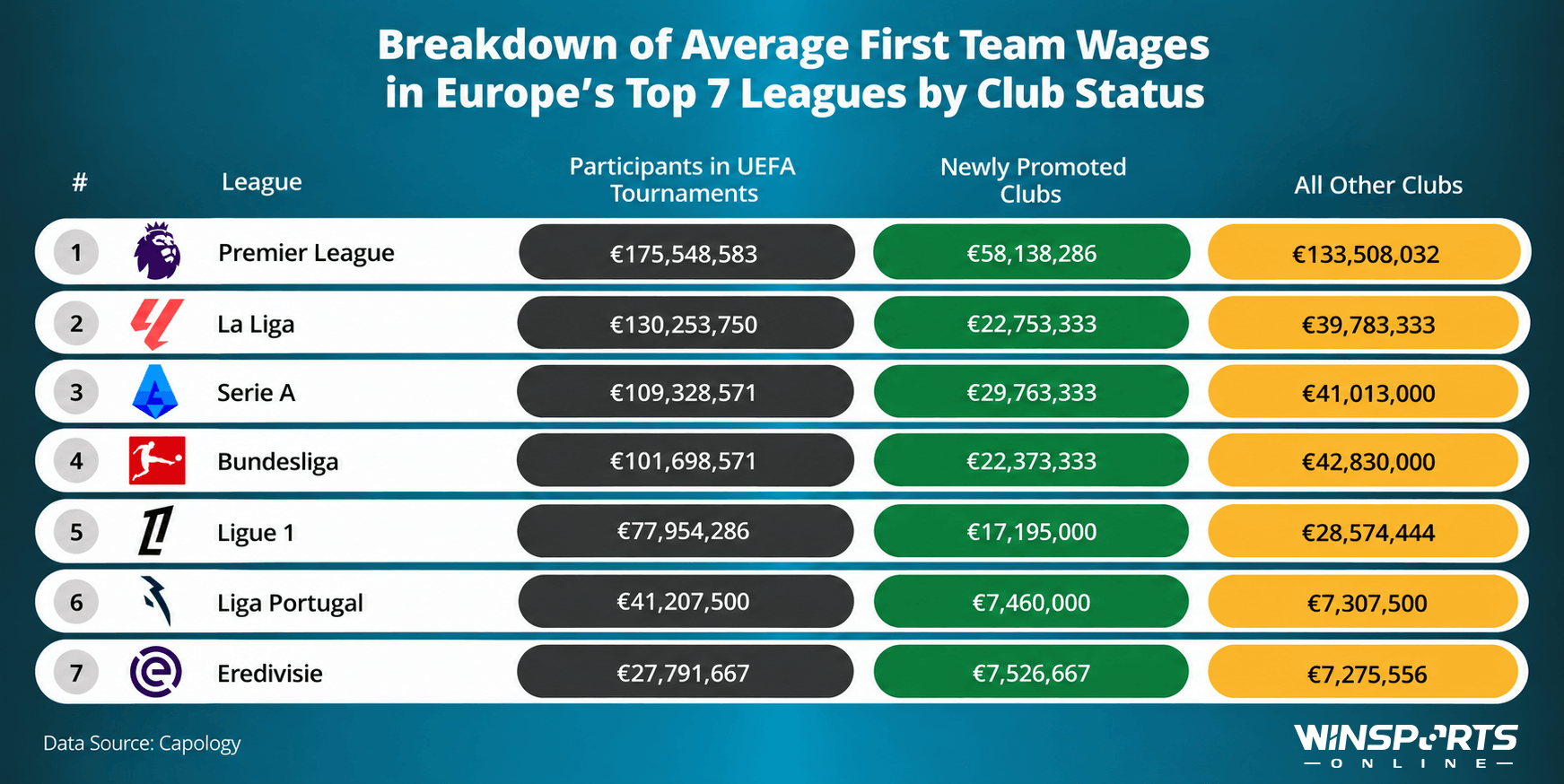
The second comparison table makes the domestic structure of each league much clearer. Rather than comparing clubs from different countries directly, it shows how each competition is divided between teams competing in UEFA tournaments, newly promoted clubs and all other sides.
The Premier League again stands out. Its European participants average €175.55m, with the clubs in neither Europe nor the promoted group still averaging €133.51m. Even outside its European places, the league operates at a level few others can match. Newly promoted Premier League clubs average €58.14m, which is below the rest of the division but far above the promoted-club figure in any other league.
La Liga has the sharpest split between its leading clubs and the rest. Spanish teams competing in UEFA tournaments average €130.25m, compared with €39.78m among the other established clubs and €22.75m for the promoted sides. Serie A and the Bundesliga show a similar pattern, though with slightly narrower gaps: European participants average €109.33m in Italy and €101.70m in Germany, compared with €41.01m and €42.83m respectively among established teams outside European competition.
Ligue 1 also follows the same broad trend, with its European participants on €77.95m, newly promoted sides on €17.20m and the remaining established clubs at €28.57m.
The two most unusual cases are Liga Portugal and the Eredivisie. In both leagues, newly promoted clubs average slightly more than the established teams outside UEFA competition. In Portugal, promoted sides come in at €7.46m against €7.31m for the other non-European established clubs. In the Netherlands, the promoted-club figure is €7.53m, marginally above the €7.28m posted by the rest of that category.
That does not mean promoted sides are richer than the typical club in those leagues as a whole. Benfica, Porto, Sporting and Braga in Portugal, and Ajax, PSV, Feyenoord, AZ, Utrecht and Twente in the Netherlands, are all removed into the group of teams competing in UEFA tournaments. What the table does show is that, once those better-resourced European participants are taken out, the remaining domestic pack in Portugal and the Eredivisie operates at a very similar level to the promoted sides entering the division.
The Premier League dominates both at the top and in depth
The three visuals together tell a very consistent story. The Premier League leads the way in total spending, average club spending and representation in the €100m wage group. It does not just place the most clubs in that elite bracket; it places 13, which is more than the other six leagues combined.
La Liga, Serie A and the Bundesliga make up the second tier of Europe’s wage landscape. All three contain major heavyweights and all three produce clubs above the €100 million threshold, but none comes close to England’s breadth of spending power. Ligue 1 sits behind that group, driven primarily by PSG’s enormous salary bill, while Liga Portugal and the Eredivisie operate on a far lower financial scale.
The internal league breakdown is just as revealing. Teams competing in UEFA tournaments are the biggest spenders everywhere, but the gap between those sides and the rest varies significantly. In Spain, Italy and Germany, the difference is especially clear. In Portugal and the Netherlands, by contrast, the most striking point is how little separates newly promoted sides from the established non-European part of the league.
The overall result is a European wage map with one dominant competition, a clear second tier behind it, and two smaller leagues where financial differences outside the European spots are much tighter.
Methodology:
We analysed the estimated gross fixed first-team wages per year of all clubs competing in the Premier League, La Liga, Serie A, Bundesliga, Ligue 1, Liga Portugal and the Eredivisie during the 2026/27 season.
The figures are based on Capology estimates and represent fixed first-team wages only. They exclude bonuses and other variable payments. All figures were standardised in euros for comparison.
For the second table, clubs were split into three groups within each domestic league:
- Clubs participating in UEFA tournaments – clubs competing in the 2026/27 league phase of the Champions League, Europa League or Conference League
- Newly promoted clubs – clubs promoted into the top flight for 2026/27
- All other clubs – clubs that are neither participating in UEFA tournaments nor newly promoted