Only Pep Guardiola and José Mourinho have overseen more than €2bn in signings as 19 more managers have crossed €1bn in spending, compared with just nine above €1bn in player-sale income
Transfer records are normally attached to clubs, but the same market can be viewed through the managers who were in charge while billions changed hands. Long careers at Europe’s biggest clubs, repeated squad rebuilds and years spent overseeing valuable squads have pushed a growing group of coaches beyond the billion-euro mark on both sides of the transfer market.
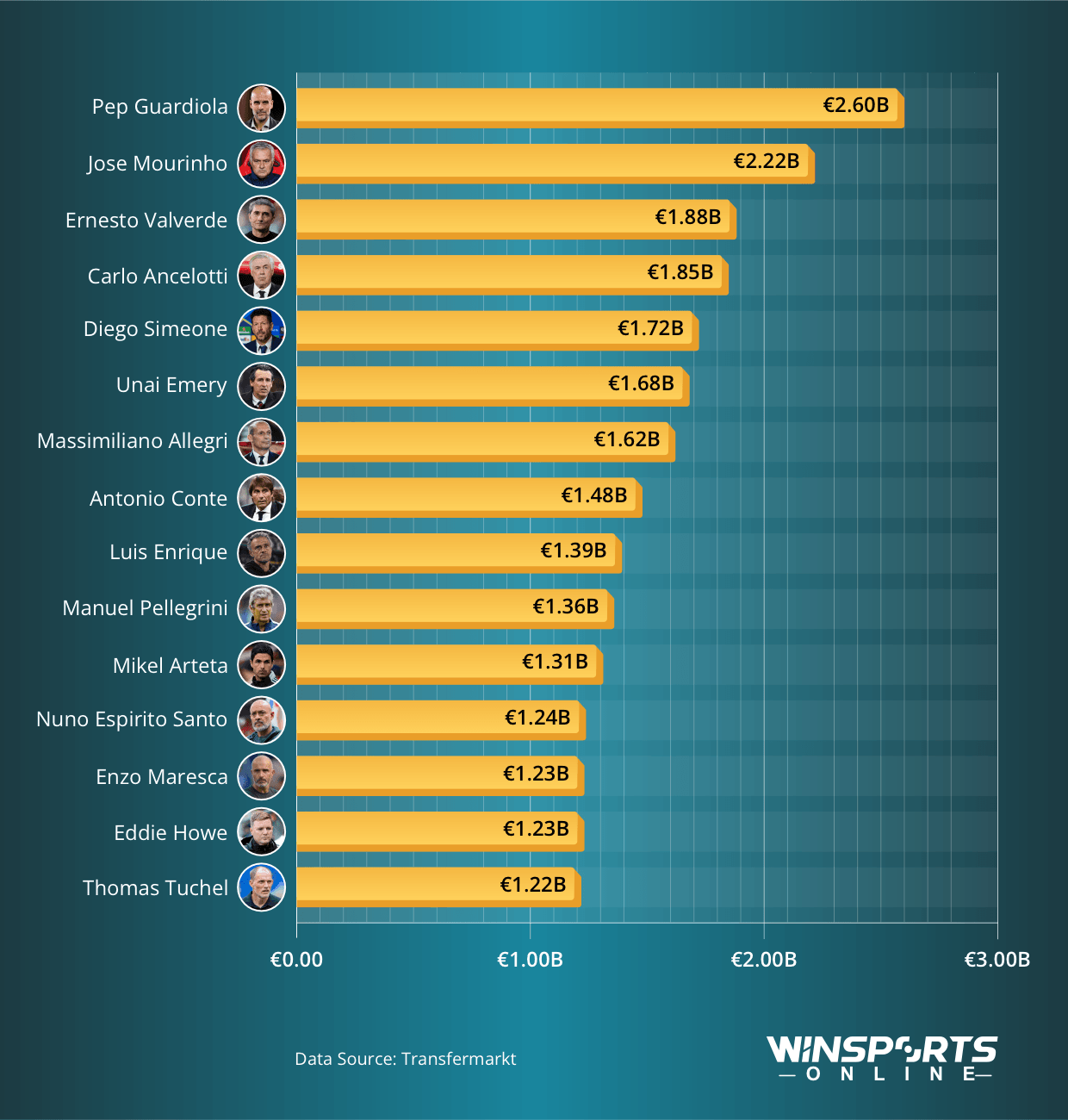
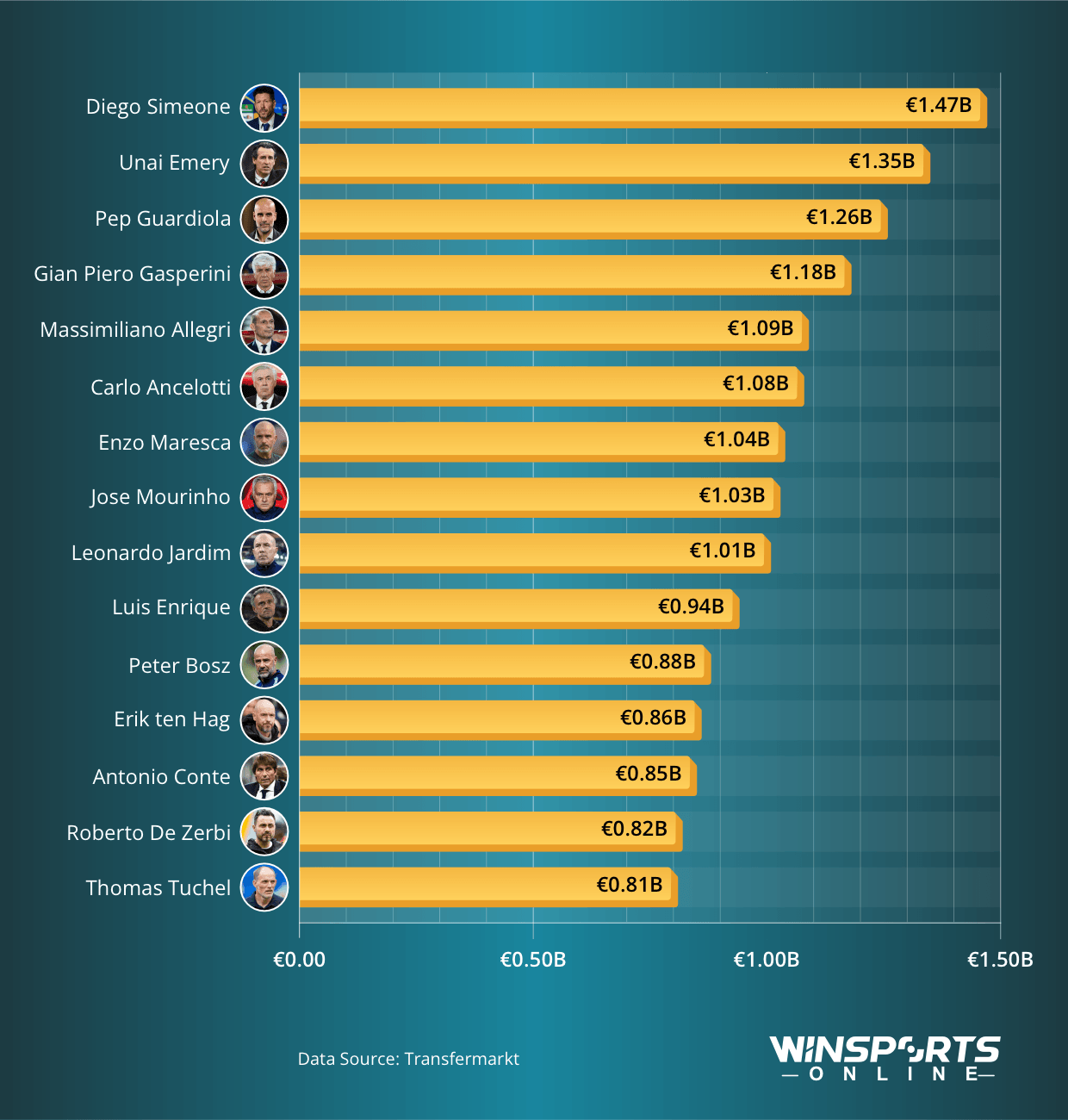
Winsportsonline analysed the transfer activity recorded during managers’ club tenures and produced two separate career rankings: the money spent by their clubs on incoming players and the income those clubs generated through player sales while they were in charge. Pep Guardiola leads the spending ranking with €2.60bn, ahead of José Mourinho at €2.22bn and Ernesto Valverde at €1.88bn. Diego Simeone heads the sales ranking with €1.47bn, followed by Unai Emery at €1.35bn and Guardiola at €1.26bn.
Guardiola and Mourinho are the only two managers above €2bn in spending, although 21 have now overseen more than €1bn in incoming transfers. On the other side of the market, only nine managers have been in charge while their clubs generated more than €1bn from player sales.
Key Takeaways:
- Pep Guardiola leads career transfer spending at €2.60bn, with José Mourinho the only other manager above €2bn at €2.22bn
- Twenty-one managers have overseen more than €1bn in incoming transfers, compared with only nine whose clubs generated more than €1bn through player sales
- Diego Simeone leads the sales ranking at €1.47bn, followed by Unai Emery at €1.35bn and Guardiola at €1.26bn
- Ten managers appear in both top 15s, although their positions differ sharply: Guardiola ranks first for spending and third for sales, while Simeone is fifth and first respectively
- Ernesto Valverde ranks third for spending but does not make the sales top 15, while Gian Piero Gasperini sits fourth for sales despite remaining outside the spending top 15
Football head coaches
with the most money spent on player transfers (billion)
Only Guardiola and Mourinho Have Crossed €2bn in Transfer Spending
Guardiola stands alone at the top with €2.60bn spent on incoming players during his managerial career, putting him €380m ahead of Mourinho. His total has accumulated across Barcelona, Bayern Munich and Manchester City, with many of the largest deals coming during his decade in England. Jack Grealish’s €117.5m move from Aston Villa remains the biggest purchase recorded under Guardiola, followed by Joško Gvardiol at €90m, while Omar Marmoush is another of the most expensive additions.
Mourinho follows at €2.22bn, making him the only other manager to break the €2bn barrier. Unlike Guardiola, his total has been built across a much larger number of clubs, including Chelsea, Inter, Real Madrid, Manchester United, Tottenham, Roma and others. Paul Pogba’s €105m move from Juventus to Manchester United is the largest individual purchase listed across Mourinho’s managerial career.
Valverde occupies a perhaps less obvious third place at €1.88bn, ahead of Carlo Ancelotti on €1.85bn. Barcelona’s spending during Valverde’s tenure included two of the most expensive deals in the ranking’s history: Ousmane Dembélé at €148m and Philippe Coutinho at €135m. Diego Simeone follows in fifth at €1.72bn and Emery in sixth at €1.68bn, meaning six managers have already passed €1.5bn.
The billion-euro club extends well beyond the top 15. Jürgen Klopp, Gian Piero Gasperini, Mauricio Pochettino, Jorge Jesus, Erik ten Hag and David Moyes have also overseen more than €1bn in purchases, taking the total to 21 managers.
That makes the €2bn mark far more exclusive. More than 20 coaches have crossed €1bn, but only Guardiola and Mourinho have managed to double it, with Valverde still €120m short despite sitting third.
Football head coaches
with the most money generated through player sales (billion)
Simeone Leads Player-Sale Income as Only Nine Managers Have Crossed €1bn
The hierarchy changes considerably when the direction of the transfers is reversed. Simeone ranks first with €1.47bn generated from player sales during his managerial spells, putting him €120m ahead of Emery and €210m ahead of Guardiola.
Some of Atlético Madrid’s biggest departures during Simeone’s long tenure illustrate how that total accumulated. Antoine Griezmann’s 2019 move to Barcelona brought in €120m, while Lucas Hernández joined Bayern Munich for €80m. Simeone’s position is particularly notable because he also ranks fifth for spending, placing him close to the top of both sides of the market.
Emery is second with €1.35bn in sales income, accumulated across a career that has taken him through Valencia, Sevilla, PSG, Arsenal, Villarreal and Aston Villa. His recent Villa tenure alone has included several major exits: Jhon Durán for €77m, Moussa Diaby for €60m and Douglas Luiz for €51.5m. Guardiola completes the sales top three at €1.26bn; Julián Álvarez’s €75m move to Atlético, Raheem Sterling’s €56.2m transfer to Chelsea and Ferran Torres’ €55m switch to Barcelona are his three largest recorded sales.
The €1bn threshold is much harder to reach on this side of the market. Only nine managers have crossed it, ending with Leonardo Jardim at €1.01bn. Luis Enrique is the first below the line at €0.94bn, meaning the sales ranking contains less than half as many billion-euro managers as the spending side: nine compared with 21.
Gasperini is one of the most striking names in the table. His €1.18bn places him fourth for sales, ahead of Ancelotti, Mourinho and Luis Enrique, despite not featuring among the 15 highest spending totals. He is, however, one of the six additional managers above €1bn in spending outside that top 15, showing how substantial his transfer activity has been in both directions.
Ten Managers Appear in Both Top 15s
The two rankings overlap substantially but far from completely. Guardiola, Mourinho, Ancelotti, Simeone, Emery, Allegri, Conte, Luis Enrique, Maresca and Tuchel all feature in both top 15s, accounting for two-thirds of each list.
Their positions show very different transfer profiles. Guardiola is first for spending and third for sales, while Simeone goes from fifth in spending to first in outgoing income. Emery follows a similar pattern, ranking sixth for spending but second for sales. Allegri moves from seventh to fifth, and Ancelotti from fourth to sixth.
Mourinho sits much higher on the spending side, ranking second with €2.22bn compared with eighth for sales at €1.03bn. Conte falls from eighth to 13th, while Tuchel occupies 15th place in both rankings. Maresca moves in the opposite direction: €1.23bn puts him joint 13th for spending, but €1.04bn in player sales lifts him to seventh.
The monetary gap between purchases and sales is also markedly different among those appearing in both lists. Maresca’s totals are separated by €190m, Simeone’s by €250m and Emery’s by €330m. Guardiola, by contrast, has €1.34bn more in spending than sales, while Mourinho’s gap stands at €1.19bn. These are not measures of managerial profitability or efficiency — the careers, clubs and transfer environments involved are too different for that — but they help illustrate why ranking only one side of the market gives an incomplete picture.
Valverde Is Third for Spending but Outside the Sales Top 15
Some of the biggest differences become visible through the names that appear in only one ranking. Valverde is the clearest example on the spending side: his €1.88bn places him third overall, yet he does not feature among the 15 managers with the highest sales income.
Manuel Pellegrini, Mikel Arteta, Nuno Espirito Santo and Eddie Howe also make the spending top 15 without entering the sales ranking. On the other side, Gasperini, Leonardo Jardim, Peter Bosz, Erik ten Hag and Roberto De Zerbi appear among the 15 highest sales totals without making the spending top 15.
That separation reinforces the distinction between the two rankings. High career spending can come from repeated appointments at clubs with large recruitment budgets, while high sales income depends on the value of the squads being moved on and the transfer models of the clubs involved. The same manager can therefore sit at the top of one list, both lists, or neither despite overseeing substantial transfer activity.