Spain tops both rankings with 85 players and six head coaches, France has 73 players but no manager, while Yaya Touré becomes the first African to lead a club into the Champions League main phase
The 2026/27 Champions League league phase is underway, bringing together 36 clubs and hundreds of players from across the world. Behind the star names and club rivalries, the squad lists reveal another side of the competition: which countries are supplying the most footballers to Europe’s biggest club tournament, and whether the same nations are also producing the coaches leading them.
Winsportsonline analysed the official UEFA List A registrations of all 36 Champions League participants and grouped the 856 registered footballers by nationality. We then carried out the same exercise with the head coaches of every club to compare representation on the pitch with representation on the touchline. Viking are officially led by two co-head coaches, meaning the 36 clubs have 37 individual head coaches between them.
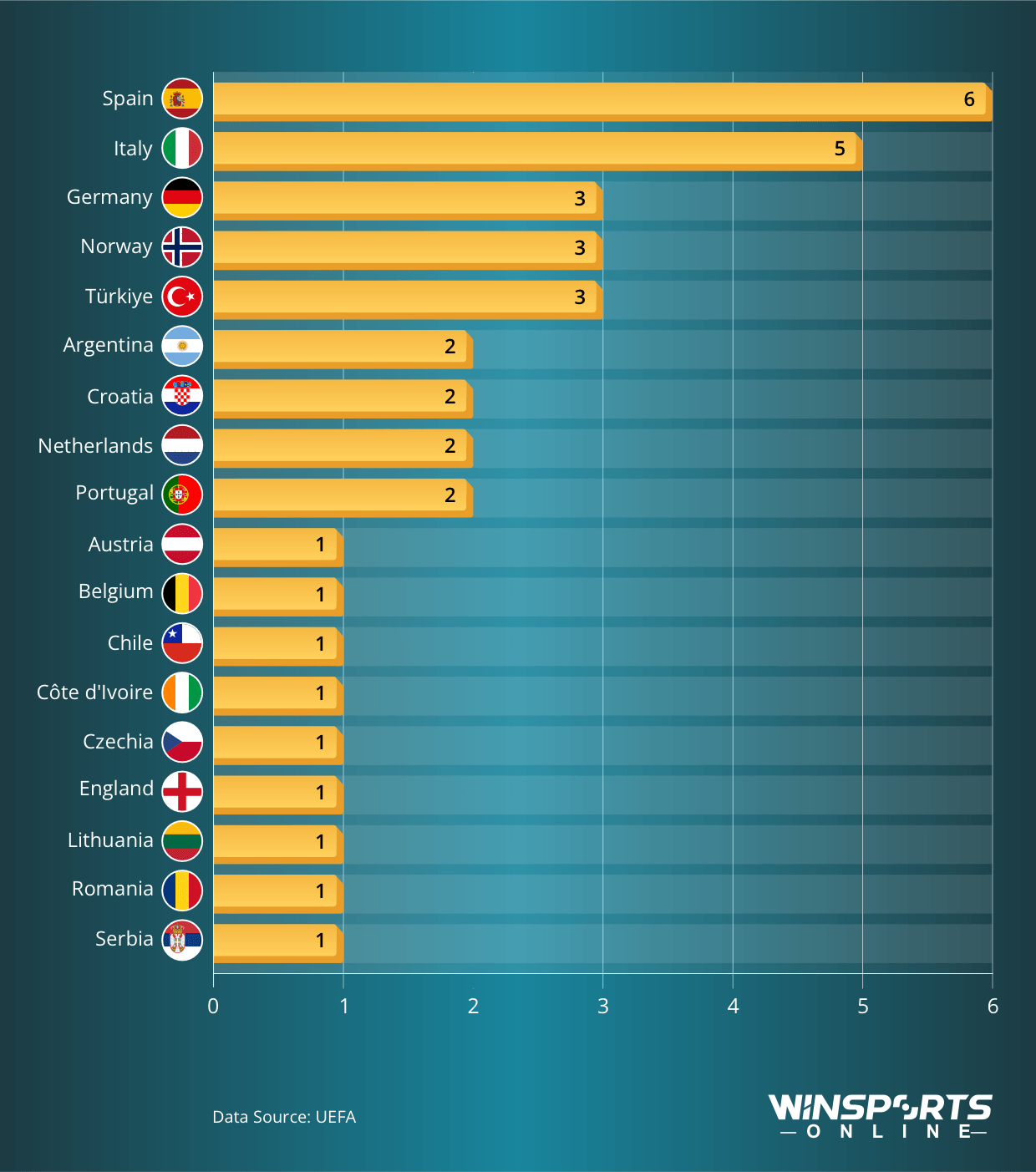
The data shows a remarkably broad player pool: 87 different nationalities are represented in the competition, but Spain stands above the rest. There are 85 Spanish players on List A squads, ahead of 73 Frenchmen, while Brazil and Germany share third place with 55 each. Spain also leads the coaching ranking with six head coaches, ahead of Italy with five.
The two rankings, however, tell very different stories beneath the top spot. France has the second-largest player contingent but not a single French head coach, while Brazil is tied for third among players and is also absent from the coaching list. Italy moves in the opposite direction, ranking only eighth among players but second among coaches.
Key Takeaways:
- Spain is the most represented nationality in the 2026/27 Champions League with 85 List A players and also leads the coaching ranking with six head coaches
- France ranks second with 73 players but has no French head coach among the 37 coaches leading this season’s 36 clubs
- Brazil and Germany are tied on 55 players, but Brazilians are spread across 25 clubs compared with 15 for Germans
- Norway ranks seventh with 42 players despite appearing across only eight clubs, with 36 of those players registered by Bodø/Glimt and Viking
- Yaya Touré is the only African head coach in this season’s league phase and became the first African coach to guide a club into the Champions League main round
Countries with 10+ Players Registered
for the 2026/27 Champions League
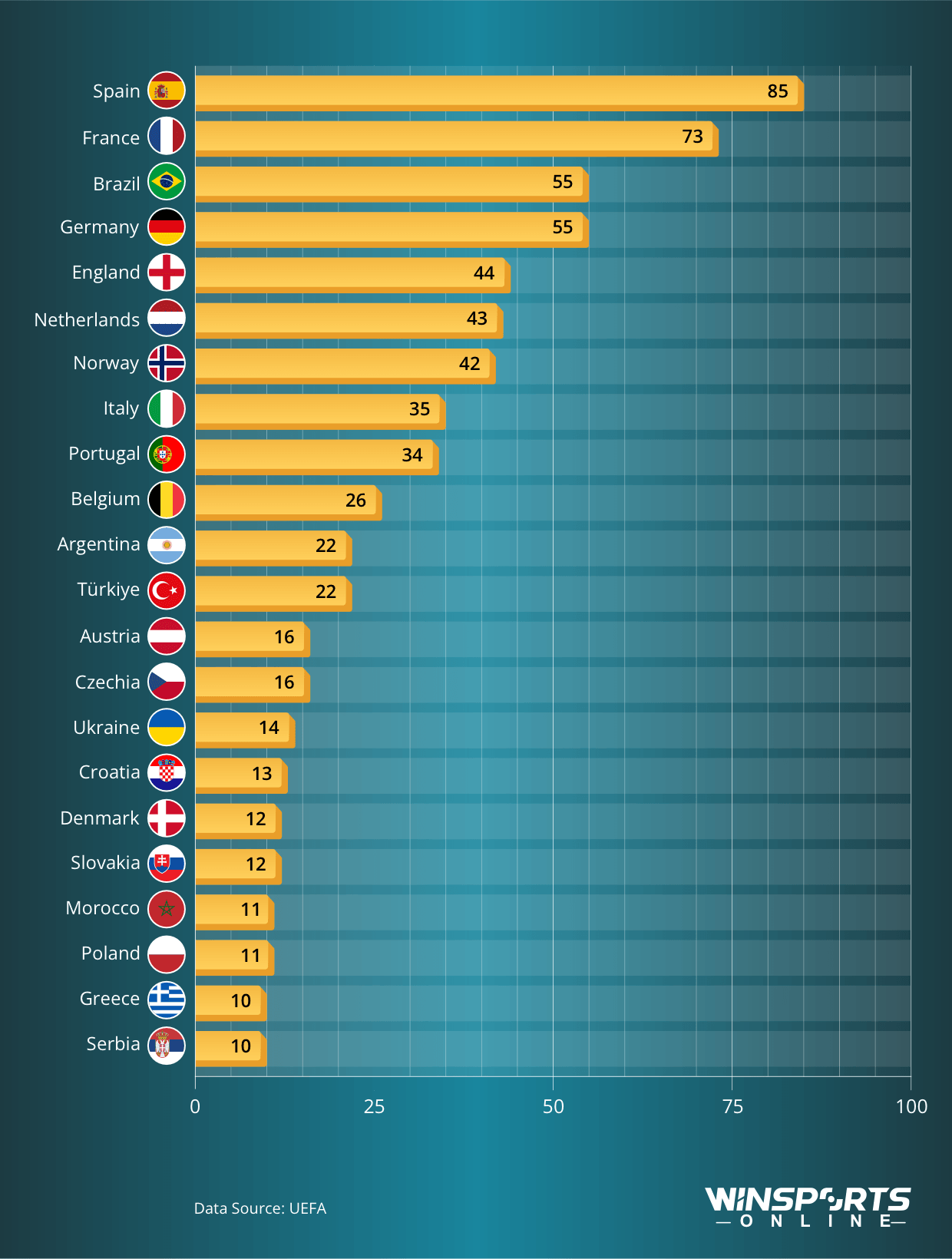
Spain provides almost one in every ten List A players in this season’s Champions League. Its 85 registered footballers account for 9.9% of the entire 856-player pool and put the country 12 players clear of France in second place. The Spanish presence also stretches well beyond the five La Liga clubs in the competition. Spanish players feature across 20 of the 36 Champions League squads, demonstrating how widely the country’s footballers are distributed around Europe. France has an even broader club footprint, with its 73 players spread across 22 teams.
Brazil and Germany form the next tier, tied on 55 players each, followed by England on 44, the Netherlands on 43 and Norway on 42. Italy and Portugal have 35 and 34 respectively, while Belgium completes the top 10 with 26. Together, the ten most represented nationalities account for 492 of the 856 List A places, or 57.5% of the entire player pool.
Brazil Has the Widest Reach, While Norway’s Numbers Are Concentrated at Home
The tie between Brazil and Germany disappears when the number of clubs represented is considered. Brazil’s 55 players are spread across 25 different Champions League teams, more than any other nationality in the competition. Germany has exactly the same number of players but they appear across only 15 clubs.
That makes Brazilian representation particularly striking. Brazil has no club in the Champions League, yet its players can be found in almost 70% of the teams taking part.
Norway represents the opposite extreme. Its 42 players place it seventh overall, just two behind England and one behind the Netherlands, but Norwegian footballers appear across only eight clubs. The explanation lies largely with the country’s two representatives: Bodø/Glimt and Viking account for 36 of the 42 Norwegian players between them, leaving only six spread across the rest of the competition.
Türkiye shows a similar, though less extreme, concentration. Its 22 players rank joint 11th overall but are spread across only six clubs, reflecting the sizeable Turkish contingents at Fenerbahce and Galatasaray.
2026/27 Champions League Head Coaches Ranked by Nationality
Spain Also Produces More Champions League Head Coaches Than Any Other Country
Spain’s lead is not limited to the pitch. Six of the 37 individual head coaches in this season’s competition are Spanish, giving the country first place in the coaching ranking as well.
Mikel Arteta at Arsenal, Unai Emery at Aston Villa, Cesc Fàbregas at Como, Andoni Iraola at Liverpool and Luis Enrique at Paris Saint-Germain are all working outside Spain, while Iñigo Pérez leads Villarreal. That means five of the six Spanish coaches in the Champions League are currently managing foreign clubs.
Italy follows with five head coaches despite ranking only eighth in the player standings. Germany, Norway and Türkiye share third place with three coaches each, while Argentina, Croatia, the Netherlands and Portugal have two apiece. UEFA’s club profiles list the current coaching appointments across all 36 league-phase teams.
The coaching pool is far narrower than the player pool. While 87 nationalities are represented among List A players, only 18 appear among the head coaches. The difference is especially striking for some of football’s biggest talent-producing countries.
France Has 73 Players but No Head Coach
No country illustrates the contrast between player and coaching representation better than France.
France has 73 registered players, the second-highest total in the competition, and French footballers appear across 22 different clubs. Yet none of the 37 head coaches is French.
Brazil presents a similar picture. Its 55 players rank joint third and are spread across a competition-high 25 clubs, but there is no Brazilian head coach in the league phase.
Italy sits at the other end of the spectrum. Its 35 players place it eighth in the player ranking, behind Spain, France, Brazil, Germany, England, the Netherlands and Norway, but its five coaches are second only to Spain.
The comparison shows that the countries supplying the greatest number of Champions League footballers are not necessarily the same countries producing the managers trusted to lead clubs at this level.
Yaya Touré Becomes the First African Coach to Reach the Champions League Main Round
The coaching ranking also contains one historic first.
Yaya Touré, who guided Slovan Bratislava through qualifying, became the first African coach to lead a club into the main phase of the Champions League when his Slovan lost to reigning champions PSG. The achievement has come in Touré’s first role as a head coach.
Touré’s presence on the touchline adds another dimension to a competition whose playing squads already stretch across 87 nationalities. The Champions League may be increasingly international on the pitch, but the much narrower spread among its head coaches shows that the same diversity has yet to be reflected fully in the dugout.